Since you liked Isabella Rossellini's seduce me series, here's more...
It's strange underwater sex in the animal kingdom, from planet 100. Featuring transgender fish, sex circles of hermaphrodites, well-endowed barnacles (see video, wow), and more.
Tweet
Showing posts with label strange animals. Show all posts
Showing posts with label strange animals. Show all posts
Thursday, July 15, 2010


Monday, March 15, 2010
Shrimp on ice
 What lives under Antarctic Ice? Scientists thought maybe nothing, except those silly little microbes that live everywhere. But guess what happens when you do an actual experiment, sometimes you find a big surprise.
 Like the false bologna sandwich hypothesis, the now-discredited "nothing big lives under the ice" hypothesis is toast.
As soon as scientists placed cameras under the 600 foot thick Antarctic ice sheet at the bottom of a hole drilled through the ice, a cute little 3 inch long orange shrimp settled down on the camera cable and stared at them (photo at top left). Wondering, no doubt, how creatures can live outside of the nice comforting dark water that's always the same comforting temperature of 272 degrees Kelvin.
That's right folks, harsh is in the eyes of the beholder. An Antarctic shrimp must find it's own habitat to be quite nice, and a tropical beach in the Bahamas would be like being cooked in boiling water. It's all what you're used to. Tweet
Monday, May 12, 2008
Pelican vs. swimmer
 Who wins when a diving pelican hits a swimmer? The swimmer, a 50 year old woman, got a nasty gash on her face. The pelican died.
  It's a very unusual event, not to be confused with Hitchcock's "The Birds," which incidentally was filmed in beautiful Bodega Bay where I used to live. The birds there are quite normal.
Tweet
It's a very unusual event, not to be confused with Hitchcock's "The Birds," which incidentally was filmed in beautiful Bodega Bay where I used to live. The birds there are quite normal.
Tweet
Monday, January 21, 2008
National penguin awareness day
Just what we need to take the winter blues away, Penguin Awareness Day. I want some of what this penguins has...
Hat tip: Cephalopodcast.com Tweet
Hat tip: Cephalopodcast.com Tweet
Monday, April 30, 2007
Strange mating rituals in marine worms
 Imagine the dating game if you couldn't get out of your house. Some non-swimming marine worms respond by breaking off their tails and sending them out to mingle and mate--after growing a second rudimentary head to guide the process
It's called epitoky, and it's even more interesting than a pharyngula.
And if that's not odd enough, the epitokes are a delicacy consumed by people...they're the worm caviar of the Pacific.
There are ocean creatures stranger than anything we landlubbers could imagine.
Tuesday, February 20, 2007
Scary ocean blob creature invades Seattle
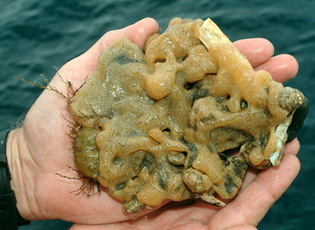
What's slimy, comes from Seattle, and smothers all competition? It's the scary blob alright, but it doesn't sell software or coffee. It's called a tunicate, and it's threatening ocean ecosystems.
 Tunicates are encrusting invertebrates, which means they are blanket-like blobs that can cover anything solid. They thrive as invaders and they're turning up in more and more ocean places.
Blogfish raised the ocean blob alarm last year, and things are only getting worse. The Blob was doing well in Hood Canal last year when nearly everything else was dying from low oxygen. There's a blob alert website with info on identifying the blob and advice on what to do if you find one.
 Tunicates are encrusting invertebrates, which means they are blanket-like blobs that can cover anything solid. They thrive as invaders and they're turning up in more and more ocean places.
 Blogfish raised the ocean blob alarm last year, and things are only getting worse. The Blob was doing well in Hood Canal last year when nearly everything else was dying from low oxygen. There's a blob alert website with info on identifying the blob and advice on what to do if you find one.
The best tip? Get ready for Soylent taupe.
Photo: USGS/NOAA
Friday, December 22, 2006
Live giant squid film!
 See a real sea monster, a giant squid filmed and captured alive. This is actually a small one, only 24 feet long--giant squid reach up to 60 feet.
Giant squid are the real KRAKEN, an ocean monster from ancient legend. Japanese scientists put out some bait and lured this mysterious and fantastic squid out of the depths.
Squid are actually molluscs, related to clams, oysters, snails, octopus, and the cuttlefish. Yes, molluscs are some of the most lovable and cuddly creatures in the ocean. Tweet
Wednesday, December 06, 2006
Ok Go Shrimp
 Here they go again. Check out the latest thing in ocean entertainment, a music video featuring shrimp.
 Not just shrimp, but shrimp on a treadmill, banking on the runaway success of Ok Go's 4 guys dancing on treadmills. Of course, shrimp have an advantage, with 10 or what looks like 24 legs, it's much easier for a shrimp to create a spectacle on a treadmill.
It could be that Ok Go Shrimp gets even bigger than blobfish. Ocean celebrities are everywhere these days. Tweet
Monday, November 27, 2006
Ocean blob fears grow
News of the scary ocean blob creature has people on edge. Blogfish brought you news of the nasty blob invasion 6 months ago.
 Now the blob is starring in reports from web media, major newspapers, and less ocean-savvy blogs. Some are talking in horror movie terms like "a giant blob is swallowing up everything in it's path" and worrying that it will smother scallops and fish.
What to do? The best way to stop the blob is to rebuild healthy oceans, since invaders usually thrive best where habitats are torn up by people and natives are removed. Likely help for the blob comes from bottom trawling and dredging that tear up habitats along with fishing that has dramatically reduced populations of valuable native fish and shellfish.
Stay with blogfish for all the ocean news that's fit to blog, well before you hear it elsewhere. And we have the best links. Tweet
 Now the blob is starring in reports from web media, major newspapers, and less ocean-savvy blogs. Some are talking in horror movie terms like "a giant blob is swallowing up everything in it's path" and worrying that it will smother scallops and fish.
 What to do? The best way to stop the blob is to rebuild healthy oceans, since invaders usually thrive best where habitats are torn up by people and natives are removed. Likely help for the blob comes from bottom trawling and dredging that tear up habitats along with fishing that has dramatically reduced populations of valuable native fish and shellfish.
Stay with blogfish for all the ocean news that's fit to blog, well before you hear it elsewhere. And we have the best links. Tweet
Wednesday, November 15, 2006
Ocean snails relieve chronic pain
 Not just another pretty shell, an ocean cone snail may help people with chronic nerve pain like sciatica.
Ocean cone snails are beautiful but deadly, with toxic venom that can be fatal to humans. Isolated and used carefully, certain toxins can be useful medicines for difficult tasks such as pain relief.
The new finding is a treatment for neuropathy, the nearly-untreatable chronic pain that comes from nerve injury or pressure on nerves from tumors, swelling, or back injuries.
Cone snails are fascinating creatures, they use a modified tongue as a type of "harpoon" that injects toxin into victims, so the slow-moving snails can capture and eat fast-moving prey like fish. Sounds like something from a horror movie, good thing there are no large cone snails that live on land. Tweet
Tuesday, September 05, 2006
Female seahorses play the field?
 Seahorse relationships are strained by female promiscuity, a surprising finding for animals thought to mate for life.
It seems that the males, burdened with pregnancy, birth and child-rearing, stay true to their mates. Female seahorses, with fewer family obligations, are more likely to be engage in promiscuis sexual behavior and mate with other males.
Scientists have enlisted aquarium voyeurs in the study of the sex lives of seahorses. Seahorses were fitted with tiny color-coded necklaces and aquarium visitors are asked to watch seahorses mate and report on exactly who is mating with whom at Sea Life Centers in the UK and Germany. Things to watch for include colour-changing, twining tails and leaning towards each other quivering.
When aquarium visitors find out about this project, "their curiosity is immediately aroused and they seem happy to watch for quite long periods to see if there's any hanky-panky going on," said biologist Stefan Inselmann. Tweet
Friday, August 18, 2006
Killer whales kiss and make up after squabbles
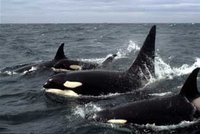 Despite the fearsome name, killer whales seem to be a model for peaceful reconciliation after disagreements.
According to scientist Michael Noonan, killer whales kiss and make up after fighting. Maybe there's a lesson for humans in the behavior of these fearsome and toothy beasts that could tear each other apart.
The make up period for killer whales consists of 6-10 minutes of synchronized side-by-side swimming. Killer whales now join primates as examples of animals with specific peacemaking behaviors.
 Noonan thinks we can use killer whales to study the evolution of peacemaking in complex societies. Perhaps there are lessons here for us...is there a place for court-ordered synchronized swimming to help feuding people soothe and settle?
Tweet
Noonan thinks we can use killer whales to study the evolution of peacemaking in complex societies. Perhaps there are lessons here for us...is there a place for court-ordered synchronized swimming to help feuding people soothe and settle?
Tweet
Monday, July 24, 2006
Jellyfish bloom in Japan
 A nuclear power plant in Japan had to slow down because jellyfish blocked the cooling water intake. The nuke plant is not alone, Japanese fishermen have also been plagued by blooms of giant jellyfish in recent years, some as large as sumo wrestlers.
Whither our ocean when jellyfish are the new fish? Is this Jeremy Jackson's "rise of slime?" Tweet
Thursday, July 13, 2006
Our fishing future--jellyfish?
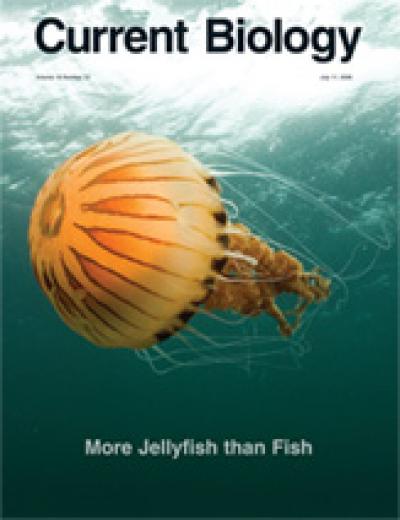 Is this the best trophy our grandchildren can hope for, a 65 cm long 8 kg jellyfish?
Jellyfish now dominate some African waters and fishermen are finding jellies in the way when they're after their favorite fish. Quite a surprise for the Benguela, an important upwelling zone off Namibia that was once the home of rich fisheries. Opportunistic jellyfish have taken over thanks to decades of heavy overfishing.
With jellyfish recipes now appearing in the media, how long until people forget about the "good old days" of those fish with the nasty bones?
Ridiculous? Check out Shifting Baselines if you think it can't happen. Or the big fish photo gallery to see the forgotten giants of just a few years ago. I'm old enough to remember what seems impossible today, a cooler full of coho salmon and giant rockfish, now both sadly depleted and protected.
Think the rise of jellyfish can't happen here? Check out the bad news from Gulf of Mexico, Chesapeake Bay, California, and even the Bering Sea and George's Bank.
Yikes!
Now back to the important question--do you prefer chardonnay or pinot grigio with your chili-sesame jellyfish? Tweet
Tuesday, June 27, 2006
Cold water coral discovery off Washington
 Coral jungle discovered in the cold Pacific waters of the US northwest.
"It was really breathtaking," said researcher Mary Sue Brancato, describing "huge red sea corals atop boulders that had rockfish all over them."
Sadly, most of the sites have been damaged by fishing. Some were "festooned" with abandoned fishing gear, and others were crushed or overturned, with the telltale tracks of bottom-trawling fishing nets nearby.
Despite being in the Olympic Coast National Marine Sanctuary, most of the sites are unprotected. Recently enacted coral protection zones were placed elsewhere, where few people fish, at the behest of the fishing industry.
Who's driving the boat? Tweet
Tuesday, May 09, 2006
Monsters of the deep ocean

Who wants to confront this scary animal in the dark waters of the Bermuda triangle?
Especially when it's related to the stinging Portugese man-of-war and some animals that can reach 40 meters in length.
No worries. Despite it's Darth Vader appearance, this one is a harmless small siphonophore, called Hippopodius hippopus. It was found by the Census of Marine Life along with many other amazing and interesting sea creatures.
Now I know what I want to be next Halloween. Tweet
Subscribe to:
Posts (Atom)