
Alaska hates farmed salmon...until Alaska produces them and re-brands them "wild."
It's a little-known fact that many of Alaska's so-called
"wild" salmon start their lives in a fish farm before being allowed to escape into the ocean.
Do you think I'm kidding? Read this just released by the
Prince William Sound Aquaculture Corporation:
Pink salmon in the Prince William Sound (Alaska) are a modern, man-made marvel. Hatcheries operated by the Prince William Sound Aquaculture Corporation and the Valdez Fisheries Development Association (VFDA) are responsible for virtually all of the pink salmon harvested in Prince William Sound.
A man-made marvel? These so-called "wild" Alaska salmon start their lives in fish farms before escaping into the ocean and being caught as "wild."
What do these salmon look like in a store?
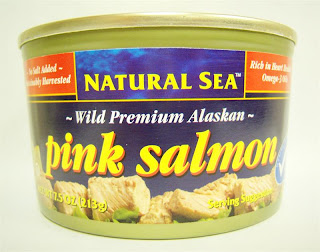
And what does the
salmon industry tell us about these salmon?
Salmon newly hatched from eggs remain in fresh water for about a year before heading out to sea. The fish feed and grow in the ocean for an average of four to seven years. Remarkably, each fish will return to the exact stream in which it hatched to spawn and die.
Oh really?
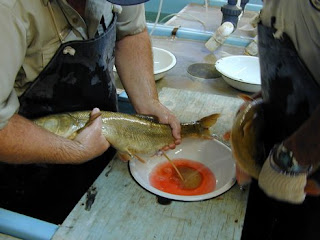
Nothing about people collecting eggs in a bucket (see photo at right)?
I suppose describing this picture in a "wild" salmon brochure wouldn't produce the same image of romance and charisma...
...two men lean over a bowl in a laboratory with eager anticipation as the first eggs begin to spill out of the female salmon, soon to be followed by miracle of fertilization...the fertilized eggs are then stacked on temperature-controlled racks to be monitored daily until they hatch and are released into the cold clear waters filling concrete ponds, their home until they get big enough to swim out to sea...
Moving on, what does the salmon industry tell us is the
biggest enemy of Alaska's wild salmon?There is, however, a threat to this heaven-sent fish that concerns all who love to catch and consume Wild Salmon. The threat is Farmed Fish. With the increasing popularity of salmon farms around the world, commercial fishermen aren't the only ones paying the price. Penned fish have an increased risk of disease. Fish escaping from these farms, into the open ocean, pose a serious hazard to the health of wild salmon stocks.
Say what?
The biggest problem for wild salmon is when farmed salmon escape from fish farms into the ocean? But letting farmed salmon escape into the ocean is exaclty how Alaska produces most of it's pink salmon and many of it's other salmon (sockeye, coho, and chinook--also known as king salmon). In some places in Alaska, so-called "wild" salmon catches are dominated by hatchery fish, even for the most prestigious chinook (king) salmon. These
man-made salmon are hugely popoular among the people of Alaska, based on public support for the hatchery program.
The fine words about wild Alaska salmon are hardly matching the reality, and almost everyone in Alaska seems OK with that. Maybe the real cause of Alaska's opposition to fish farms is market competition between Alaska's hatchery-supplemented "wild" fish and farmed fish produced elsewhere.
We'll come back to the probems further down, first let's hear from the Alaska Department of Fish and Game says about the recent boom in so-called "wild" salmon production from Prince William Sound, quoted in
Alaska DispatchThe average annual harvest for the most recent decade-long period stands near 45 million salmon per year. How salmon harvests in the Sound doubled, and then doubled again, has everything to do with human alterations to the environment. But not in the form of spilled oil.
"It's the hatchery fish,'' said John Hilsinger, commercial fisheries supervisor for the Alaska Department of Fish and Game. "There's a real large number of hatchery fish."
There can be no doubt, Alaska is dependent on farm-produced salmon that escape by design into the ocean. Statewide totals are
1.2 to 1.4 billion salmon each year that are raised in hatcheries and released into the ocean, accounting for 14% to 37% of annual salmon catch. Overall odds are about 1 in 4 that a so-called wild Alaska salmon actually started it's life in a fish farm.
According to
Trout Unlimited, the statewide figures by species in 2000 were:
64% of the 2000 statewide Alaska commercial harvest of chums, 42% of pinks, 24% of coho, 4% of sockeye, and 19% of Chinook salmon were of hatchery-produced fish.
Is the salmon industry worried about these salmon that are allowed to escape intentionally from fish farms? No, in fact the salmon industry is eager to expand hatchery production of salmon in Alaska. From the
Alaska Dispatch:
So why not do more to boost the salmon economy in the Sound? What's wrong with a bigger fish spill?
That is a hard question to answer. A lot of people think helping out nature by adding things -- can you say "bird feeder"? -- is a good thing. Only when it comes to subtracting things -- can you say "aerial wolf hunt"? -- or adding ugly things -- can you say "oil spill"? -- do people get upset about nature tampering.
Even officials at the Alaska Department of Fish and Game -- having originally questioned the hatchery expansion -- are now in the process of approving most of PWSAC's requests for expansion. What else are they going to do?
"You're not going to shut down the hatcheries,'' Eggers said. "The Sound is supported by hatcheries now. The (fishing) industry depends on hatcheries."
Is this a problem? Also quoting from
Alaska Dispatch:
"Our obligation to manage wild (salmon) stocks in Prince William Sound is very challenged at current levels of population,'' an April memorandum from the Alaska Department of Fish and Game warns. "Department straying studies suggest that at current production levels, hatchery salmon straying may pose an unacceptable risk to wild salmon stocks."
This warning comes from a
review of Alaska's salmon hatcheries by the University of Alaska:
Based on a review of the scientific literature and discussions with biologists, geneticists, and fishery managers about protecting salmon biodiversity, the potential impacts of extensive ocean ranching appear to pose a great concern...
Fisheries scientist Ray Hilborn, who is often a good friend of the fishing industry, has this
stark warning about artificial production of salmon, especialy when it's desgined to boost fishing:
Artificial propagation is often seen as a way to maintain and increase or augment fish stocks that have suffered from habitat loss and overexploitation. Large-scale hatchery programs for salmonids in the Pacific Northwest have largely failed to provide the anticipated benefits; rather than benefiting the salmon populations, these programs may pose the greatest single threat to the long-term maintenance of salmonids. Fisheries scientists, by promoting hatchery technology and giving hatchery tours, have misled the public into thinking that hatcheries are necessary and can truly compensate for habitat loss. I argue that hatchery programs that attempt to add additional fish to existing healthy wild stocks are ill advised and highly dangerous.
This is not a new issue. Scientists and conservationist have been
critiquing salmon hatcheries for a long time, although Alaska has better practices than some other areas and has so far escaped the worst criticism.
Blogfish has been knocking on this door for years, and salmon farming advocates have been calling for a more truthful comparison between
farmed salmon and Alaska's so-called wild salmon.
Maybe we're finally starting to see a broader recognition that there is a bit of mythology behind the reputation of Alaska salmon.
 It's Copper River salmon time again, and everyone here in Seattle is looking forward to some lovely fresh salmon. I'll be waiting a couple of weeks until prices come down, the first shipments tend to be expensive.


