Sunday, July 09, 2006

Who says fish need water?

Politics are killing salmon in the Klamath River, when politicans let farmers take too much water for their fields, and there's not enough water left for salmon.

This has trickle-down effects, the commercial salmon fishing season was nearly closed because there are too few fish and out-of-work fishermen are seeking state and federal aid. The struggle to save the Klamath salmon has a long and difficult history, and the political connections seem to go all the way to the White House.

It's a tough issue, a federal irrigation project built many years ago has built wealth and jobs, but it's now a culprit in fish deaths. The farmers make poor villians, they're just making a living using water that they believe belongs to them.

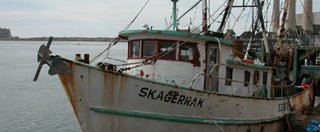
If we can't resolve crises like this, then we can see who loses the most (picture above right).

Saturday, July 08, 2006

Killing fish by ignoring science

Fish would have been among the losers if important research on logging effects had been censored. Fortunately, this time the truth came out and contrite officials have been forced to apologize.

The controversy started when Daniel Donato, a graduate student at Oregon State University (affectionately known as Timber State U in the region), discovered that salvage logging slowed regrowth of a forest after a fire.

Big deal, right? People discover things all the time. But when he tried to publish his findings in a prestigious scientific journal, he and his co-authors found themselves attacked by Professors, University officials, an Oregon state senator, a federal agency, and some members of the US Congress. Yikes!

I've seen similar power plays in support of logging when I was working on watershed and salmon health in Oregon, and it's not a pretty sight. I wonder how many times this type of censorship has succeeded?

Friday, July 07, 2006

Buying conservation in the ocean

Fishermen paid to stop destructive bottom trawling off California, in a new twist to the Nature Conservancy's market-based approach to conservation.

This effort should help ocean bottom habitats recover, and support rebuilding of depleted bottom fish.

Famous for promoting conservation by buying land from willing sellers, the Nature Conservancy is getting wet and salty with a partner group Environmental Defense. The groups do not intend to end all fishing, when fish recover they hope to promote fishing using sustainable methods.

Buying conservation is more complicated in the ocean, here's to hoping that this approach works.

Thursday, July 06, 2006

Heroic measures to save fish?

When do we let endangered fish go extinct? For Redfish Lake sockeye salmon, the time is now says the so-called "God Squad." Is it worthwhile to spend millions of dollars trying to save these unique and distinct salmon that swim over 900 miles and up to 7000 feet elevation from the Pacific Ocean to spawn in landlocked Idaho's Redfish lake? Or, is it appropriate mitigation to spend money on sockeye in exchange for dams that have spread benefits to many but hurt the fish?

The Redfish Lake sockeye rescue effort is an interesting story in trying to hold off extinction, in hopes for restoring once-vibrant fish populations.

Some say that society made the choice when we chose to build the dams, and we should let the fish go extinct. But we were promised that we could have the dams and the fish too.

We brought back the bald eagle, and the osprey, and now they're thriving. Was this worth the cost? Some say we should bring back DDT, that the benefits of DDT are worth the cost.

We have an obligation to try to live with nature, instead of carelessly eliminating what gets in our way. Also, we're too reliant on nature's services to blithely eliminate pieces of nature's works, in the hope that we won't eliminate anything important.

Wednesday, July 05, 2006

Singing fish and sneaky fish

Would you rather build and house and sing to attract a mate, or sneak into someone else's house? Young male midshipman face this choice early in life and must commit to a lifelong strategy. That's the plainfin midshipman (a fish), not naval cadets.

Some male midshipman opt for the straightforward competition of singing and letting females choose the best singer. But smaller "sneaker" males wait for a female to select a male and then sneak into the mating party and try to win by what's called "sperm competition."

To help, the small sneaker males have one body part that's much larger than the singers, the testes. The testes of sneaker males are 15% of their body weight, that would be 25 pounds in an average human male. This allows the sneakers to produce more sperm than the singers in an attempt to win the sperm competition. Improbable? Scientists believe that sperm competition is a part of human biology, although 25 pound testes are thankfully not part of it.