Showing posts with label fishing. Show all posts

Tuesday, August 23, 2011

Hoki fishermen ask for smaller quota in New Zealand

Since when do fishermen ask for smaller catch limits? That's what is happening in New Zealand these days, as increasing hoki populations have government managers trying to give away fish to fishermen.

But the fishermen are having none of it, they say leave the fish in the water to grow and reproduce.

This is one of the promises made by advocates of transferable quotas or catch shares, that fishermen's incentives will change and they'll be more focused on conservation. Whattya know, it seems to be working in New Zealand.

Thursday, March 31, 2011

Tsunami wipes out Japan's whaling?

Is whaling finished in Japan now that the tsunami wiped away infrastructure and perhaps the will to rebuild this beleaguered industry? People from small coastal whaling towns are reacting with shock and horror to the damage, and some don't see a future.

Japan's whaling industry was already reeling before the tsunami, so perhaps it's time to let go.

But others vow to continue whaling and the government of Japan is not pleased about newspaper stories predicting the industry's demise. Indeed, there's another side to the industry beyond the traditional and cultural relevance that keeps Japan going after whales.

The big distant-water boats that fish in the southern Oceans are government-run, and at least some of them are undamaged because they were out at sea when the tsunami struck. There are plenty more battles to be fought before all Japanese whaling stops. One sticky reason for Japan's persistence might be the cushy jobs for bureaucrats that the whaling industry generates.

Besides that, there are the international precedents that would be set if Japan caves in to foreign demands to stop whaling. What comes next, cutbacks in tuna fishing? Reduced access for Japan's fleets to other resources?

Wednesday, March 23, 2011

War dividend for fish

What's the best way to save fish? Start a war.

Cod and haddock boomed in the North Sea while people were busy bombing and booming each other and not fishing.

It's not a big surprise really, if we don't catch fish then they can grow up and accumulate in the ocean. Sort of like an MPA--an ocean refuge for fish.

Of course, it hasn't escaped my attention that wars have some harmful consequences, but that's another subject altogether. We're just talking fish here.

hat tip: Branch knol

Monday, March 21, 2011

Ross sea toothfish decline?

This is very bad. An Antarctic toothfish fishery with a controversial sustainability certification may be the cause of a substantial fish decline. In a charismatic place that scientists care about...a lot.

Toothfish seem to be disappearing from McMurdo Sound in the southern Ross Sea thanks to the eco-labelled Antarctic toothfish fishery. This from deliberate and methodical scientists, not finger-wagging enviro radicals.

If this proves true, it's hard to support the credibility of the Antarctic toothfish certification by the Marine Stewardship Council. And if you have doubts, you're in good company. A star-studded cast of scientists have weighed in with doubts about the sustainability of this fishery.

Toothfish are only one of the cases that fishyfellow is doggedly blogging about at "How Sustainable are Eco-Certified Fisheries?" Want to learn more about spiny dogfish certification? How about surveillance audits of South African hake? It's not the sexiest blog in the world, but it is meat and potatoes for anyone with a scientific bent who is concerned about ocean ecosystems.

Friday, February 18, 2011

Fishery science turned upside down

Keep the little ones? That's heresy for most fishery scientists. Don't worry about bycatch? Crazy advice.

But there's an argument to be made for catching fish in proportion to their abundance in the ocean. This goes against the dogma that says selective fishing is best.

A new study says some non-regulated African fisheries are operating in a useful way by failing to select certain fish for catch. The result is a more productive ecosystem despite intense fishing pressure:

"(in some)...specific artisanal and rather unmanaged fisheries of Africa, the use of a wide range of versatile fishing methods and mesh sizes, each of which selects specific sections of a fish community, resulting in a very broad distribution of the fishing pressure on the ecosystem components, leads to high yields while maintaining the ecosystem structure, i.e., the proportions between the abundance of the different size groups. Such “unregulated”, broadly targeted adaptive fishing patterns appear to be far more effective in conserving the ecosystem than single-species management theory predicts. This pattern of development appears to be the result of strong competition between fishers and low individual catch rates, and could be considered analogous to natural predator niche specialization and co-evolution. This requires, obviously, that fishing pressure (using “low tech” gears) remains at levels compatible with the ecosystem productivity."


Wednesday, January 26, 2011

Sad remnant lake emptied of fish in 15 minutes


This looks like a simple overfishing story, a lake in Mali emptied of fish in 15 minutes. But it goes deeper.

This is a remnant of a once-fertile lake that was bigger and capable of feeding people, but desertification and climate change have turned this formerly green land into a barren place. Now, the ritual fishing is just a pitiful remnant of better days.

Sunday, December 05, 2010

Global footprint of fishing

WWF is examining humanity's footprint on the earth.  It's not a pretty picture--we're consuming 1.5 planet's worth of renewable resources each year.  Since we only have one planet, this means we're consuming the earth's ecosystems to support people.

To borrow a financial analogy, we're spending our savings account (natural capital) rather than living off the interest (renewable resources produced each year).

However you understand it, we can't keep doing that forever.

For us ocean people, a big question is how are we doing in the ocean?  The best answer seems to be that we're using too much seafood

How can this be?  Isn't everything fine if we certify fisheries as being sustainable?  No.  Sustainable fishing techniques are good, but using too much is another issue.  Fisheries footprint deals with the sheer volume of fishing on a big geographic scale.  We can use sustainable fishing techniques and still be using those techniques to take too many fish out of the ocean.

In other words, the fishery-by-fishery analysis has to be supplemented by an analysis of the sum total of ocean production that we're hauling out of the ocean.  It is possible to certify every fishery on earth and still have too MUCH fishing.  There's really no way to consider our global fishery footprint in the certification of a single fishery.

To help clarify this difficult issue, there's a new analysis that shows how fishing, considered on a global scale, has expanded and intensified in the last few decades.  This supports the view that we're taking too much in most of the oceans.  And, of course, the most productive areas have been fished first and hardest.  

There is criticism of the fisheries footprint analyses that have been done.  While it's true that details may not be correct, it's an issue that we need to evaluate.

Thursday, November 18, 2010

"Collapsing" Alaska pollock fishery rises from the dead

Alaska pollock are doing better. So say the scientists charged with studying them. I wonder if those who predicted a pollock collapse are going to say something positive?

Nah, seeing fish do better isn't quite such a good story as predicting collapse.

Just like the Fraser River sockeye boom, more pollock this year doesn't mean that everything is fine. These fish have declined to about 1/3 of peak levels seen in the last 20 years, and they're only about halfway back. Scientists expect further increases in the next few years, perhaps back to peak levels. So we should wait and see about further increases before we get out the pom-poms and start cheering.

But let's be honest and say fish are doing better when they are doing better. And we should begin to ask whether predictions of impending collapse were perhaps just a bit too pessimistic.

Monday, November 08, 2010

An end to fishing is oil spill's gift to the Gulf

What is a bigger effect on fish in the Gulf of Mexico...

The Gulf oil spill?
The Gulf oil no-fishing zone?

Some scientists are finding increases in fish and shrimp, and they think an end to fishing may help more than the oil hurt.

This is the proverbial silver lining in a black cloud. Similar ghoulish benefits have been seen when fishing was closed for some very bad reasons, like fish getting bigger during World War 2 in areas where fear of submarines caused fishermen to stop fishing, creating a so-called war dividend.

Don't get me wrong, the oil spill is bad-bad-bad. But it's amazing to see what happens when we stop fishing for a while. I'd like to see the no-fishing experiment done without an oil spill.

Monday, September 27, 2010

Orange roughy & hoki madness

More orange roughy will be caught by fishermen this year. Hoki catch limits are going up. Is this a sign of disaster or success?

Forest and Bird, an environmental group from New Zealand says we still shouldn't eat orange roughy.

Not surprisingly, the Ministry of Fisheries see it differently, increased fishing for hoki and orange roughy is a result of good management.

At least one supermarket recently decided not to sell hoki and orange roughy because they're not fished sustainably.

It's sustainable seafood madness, as claims and counter-claims cloud the waters and threaten to make everyone say "WTF?" All because we can't agree on what exactly is "sustainable." How embarrassing for sustainability advocates.

If the sustainable seafood movement works, we should expect to see increased fishing for troubled species someday. Are enviros willing and able to back off on claims that people should avoid eating a species? Or will we keep species on the "do not eat" list forever, because we're stuck in a rut? I don't know enough about these fishing increases to know whether or not they're appropriate. But I worry that some people will never say "yes" to eating orange roughy or hoki once they've started saying "no."

Monday, August 30, 2010

Ocean conservation battle in Australia

Australia is going backwards, just when they seemed like smart protectors of the Great Barrier Reef.

Scared of losing too many votes for protecting oceans, politicians in Australia are being reeled in by recreational fishing interests. This is eerily similar to a movement in the US called "Freedom to Fish.

Called a recreational fishing movement, the US Freedom to Fish was more astroturf than grassroots, largely driven by big fishing equipment manufacturers.

There are some signs that the anti-ocean conservation campaign is working in Australia. Will fishing votes defeat ocean conservation? Check out the Shame on Shimano website to see how some people are trying to fight back against the anti-ocean protection effort.

Enjoy the nice "freedom to fish" picture from the US (right). And let's wait and see if similar things make an appearance in Australia.

Friday, August 27, 2010

Too many boats chasing too few fish

Why are fishermen complaining about conserving fish? Don't we need fish to have good fishing?
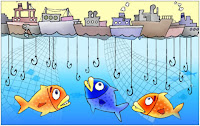
Even though it seems stupid, fishermen are complaining about ending overfishing in the US and in Europe.

What's going on? Fishermen are shooting the messenger, the scientists and managers who are saying we have to stop catching fish faster than they can reproduce.

It's not a new story, witness the children's story about overfishing. Ok, it's not exactly about overfishing, but it might as well be about overfishing.

Why does overfishing happen?
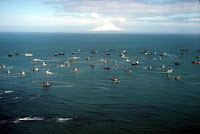
The biggest problem in modern fishing is too many fishing boats chasing too few fish--overcapacity. This simple statement applies nearly everywhere. Most people know it's bad for the fish to have too many boats, and it's also true that it's bad for fishermen. Richard Allen is a former fisherman turned consultant, and he says it's bad for fishermen to have too many boats chasing fish.

With too many boats, no fisherman makes a good living. Everyone spends lots of time and money chasing the ever-declining fish, and never catching enough to make ends meet.

But if managers propose cutting back on fishing fleets, fishermen complain about losing their jobs. Wait a minute, these are McJobs that people are losing--lousy part-time jobs that are lousy even with widespread and often counter-productive government subsidies.

The driving forces are similar everywhere. A free and open resource is there for the taking, and everybody and their brother rounds up a boat and goes out fishing. Until there are so many boats that nobody is making much money.

It's an interesting conundrum to see fishermen defending McJobs, when the same jobs in a big-box store would be reviled. Low wages, part-time work, etc. It seems obvious that they're not defending reality, they're defending the myth of fishing, the dream, the reason they got into fishing. A chance to do your own thing, make a living, and maybe get rich. It can work for one, but not for all. It's time to do a better job of reducing bloated and over-subsidized fishing fleets. It's better for fish and fishermen.

Monday, March 22, 2010

Would you rather have rain forests or oceans?

Fishing helps save rain forests. Did you know that? Ray Hilborn knows, and he thinks you should pay attention.

This is an example of a useful idea taken to a silly place. Let's compare the impacts of ocean fishing with land-based agriculture (a useful idea) and then set up a straw man of plowing the world's rainforests to replace all fishing.

What do we really learn from this comparison? That we should carry on with bad fishing just because other things are worse according to a certain set of assumptions and methods of comparison?

The real message is that there is fishing done wrong and fishing done right, and doing it right is better. End of silly comparisons.

Tuesday, February 16, 2010

Eels in deep trouble

What's long, skinny, and endangered? No, it's not Michael Jackson

Europe's eels are in deep trouble, and that situation is getting some ink now that Dutch fishermen are joining eels in the decline.

Eels are fascinating creatures, and unfortunately their complex lifecycle makes them perhaps uniquely vulnerable to overfishing, habitat damage, and other human-caused ills afflicting fish. (That's right, eels are fish).

Eels live most of their lives in rivers, but then the adults swim out to sea and spawn mysteriously in places people can't find. Baby eels drift in the ocean for nearly a year and then return to rivers as tiny and nearly invisible "glass eels" that are an expensive delicacy when eaten whole and sometimes while still alive (right).

Dutch fishery managers are responding to the plight of the European eel, thanks perhaps to eel protection campaigns by WWF and others. Fishermen wish for a different type of recovery plan, one that leaves them free to fish, of course.

Eel politics are not new, eel riots date back to the 1800s when fishermen battled police trying to break up a type of eel tug-of-war according to the New York Times. Hmmm...eels seem to invite strange behavior in people. Maybe there is a Michael Jackson connection.

Thursday, September 17, 2009

Ethically correct fish and fishing

Can a fishery be sustainable if customers waste the fish? That's the provocative question raised by scientists Daniel Pauly and Jennifer Jaquet in their critique of the Peruvian anchoveta fishery. Pauly and Jacquet say it's wasteful and wrong to use anchovies for fishmeal instead of feeding people, so it would be wrong to certify the fishery as sustainable.

For me, this stretches too far the definition of sustainable fishing. It's already difficult to find consensus around the definition of sustainable fisheries when it's just about fishing. But this messy debate gets far worse if we include issues like what happens to the fish.

Sustainability should be about not catching too many fish, limiting bycatch, and protecting habitat. We can, and do, debate the proper benchmarks for overfishing and bycatch limits. But if we get into debates about ethical uses of fish, there is no limit to the issues that someone may want to include.

Today, Pauly and Jacquet criticize feeding fish to animals not people. What's the next complaint about how fish get used? Are high-priced fish unsustainable because they're just for the privileged wealthy? Is it a problem to waste fish in processing or preparation? Is a fishery unsustainable if mercury levels in the fish are too high? Can you lose your sustainability certificate if you run a good fishery but the people who buy your fish do bad things?

Certification of fishery sustainability by the Marine Stewardship Council addresses some ethical issues. But it's a mistake to attempt to use the MSC process to address every perceived ethical problem in the seafood supply chain.

Wednesday, September 16, 2009

Monster trout a record or an abomination?

Performance-enhanced trout, can they be counted as world record fish? Rainbow trout genetically engineered for faster-than-normal growth escaped from a fish farm in Saskatchewan's Lake Diefenbaker 9 years ago. Now the world sportfishing record for rainbow trout are these genetically "juiced" fish. It's strange at best to see a world record set by these cultivated fish with an unnatural advantage.

Should this be a record fish or not? Debate rages online over whether these fish should count as records since they were spawned and fed in captivity before escaping into the lake.

The questions get stranger and stranger as human manipulation of fish (and human) performance develops. Not like the good ol' days when people got busted for pouring lead inside a fish to make it heavier.

Tuesday, September 15, 2009

Squid that eat salmon?

Everyone knows that salmon can eat squid, but how about the reverse? Would you believe that squid are eating salmon as far north as Washington state? At least that's the report from fishermen who say squid are taking salmon off their fishing lines.

These are not just any squd, they're giant Humboldt squid that can grow to be 6 feet long and weigh more than 100 pounds. Salmon fishermen are catching squid instead of salmon this year, and some are getting concerned.

A state biologist thinks the squid are moving north with the warm El Nino ocean waters, and they're likely to head south again. Global warming may lead to more problems of this type, but it's worth noting that there was a previous attack of the killer squid in the 1930's, so it's not unprecedented.

Tuesday, September 08, 2009

Sea otters vs. fishing in SE Alaska

How do we divide fish and shellfish between people and sea otters? In Alaska, sea otters are reclaiming their historic food supply, and people are unhappy.

In the absence of sea otters, fishermen got used to catching lots of fish and shellfish. Now that the otters are coming back and eating more seafood, what do we do? Do fishermen have rights to the fish, or do otters have prior rights? And how do we decide?

The first step is a scientific study. We need to figure out whether otters are really undoing human fisheries. It's not good enough to just say that otters are back and fishing is worse. If the study says otters are hurting human fisheries, then we get to the hard question. Especially since sea otters are a threatened species that can't be harassed.

We do have some examples of US government action to protect fish from natural predators by removing protected species like sea lions. But such action is rare, and typically restricted to extreme cases like sea lions that swim up the Columbia River and eat salmon out of the Bonneville Dam fish ladders, 145 miles upriver from the ocean.

Thursday, July 23, 2009

The economic value of rebuilding depleted fish

There's big money to be made with smart fishery management. That's the unsurprising conclusion of a new report.

Where overfishing has reduced fish populations, battles over what to do often center on the cost of rebuilding...how much money fishermen can lose from restrictions on fishing. Sometimes neglected is the economic value of rebuilding...how much money fishermen can make once rebuilding is complete. This study looks at the value of rebuilding in one region of the US, the Mid-Atlantic. According to the sponsors of the study:

“Results from this study provide strong analytical evidence that there is significant value in rebuilding fish populations and lost financial benefits from delayed action,” said Dr. John M. Gates, report author and professor emeritus, Departments of Economics, Environmental and Natural Resource Economics, University of Rhode Island. “It’s important to note that the primary, direct benefits represent a conservative estimate and, if related economic benefits had been included, the result would likely expand well beyond the figures estimated in this study.”

Delays in rebuilding translate to lost opportunities for commercial and recreational fishermen to catch the maximum amount of fish that can sustainably be taken from a population. Failing to quickly address overfishing and allow populations to rebuild as quickly as possible forgoes current financial benefits and may result in more costly regulations in the long–term.

I think the battle isn't so much over whether it's a good idea to rebuild, it seems to be more about who gets those benefits once rebuilding is complete. Who survives the trip through the "valley of death" that rebuilding looks like to fishermen? We need clear decisions on how to manage the transition to rebuilt fisheries.

Wednesday, May 06, 2009

Ocean zombie attack

They're the zombies of the deep. Un-dead nets that keep fishing even after they're lost by people and presumed dead. They're bad, they're deadly, and they're everywhere.

Fishing gear is designed to catch fish, and it keeps working even if lost at sea. How bad is the problem? Pretty bad, according to a new report from the United Nations Environment Group.

In some fisheries, 25% to 50% of fishing gear can be lost each year. That equals a lot of zombie fishing gear.

It's the real life ocean zombie plague, yikes.