Showing posts with label ocean uses. Show all posts

Wednesday, July 21, 2010

Obama launches ocean protection plan

America's oceans will be better protected in the future, thanks to a new ocean protection initiative from US President Obama. The new plan is to create a national ocean council to coordinate and strengthen ocean management, to create spatial planning to organize what we do in the ocean, and the emphasize ecosystem-based management.

That's a lot of bureaucratic hoo-hoo, but the result should be a more careful watch on our normal practice of doing anything anywhere in the free-for-all frontier approach we normally use in our oceans. News reports seem cautious but basically positive, so maybe people are ready for this type of smart ocean use.

Good on Obama, ocean progress!

Wednesday, November 28, 2007

Prospectors claim Pacific coast for green energy

Is this the new gold rush out west? People are staking claims to large stretches of the west coast, with plans to harness ocean energy in the form of waves and tides. This is good, right? Energy produced without making CO2.

But wait, is there anybody planning the future, figuring out what parts of the ocean are good for energy, and where we should reserve the ocean for other things? No, not yet.

We'd better watch out, or we'll get another mess like western water laws, the crazy quilt claims for using river water that make no sense and harm conservation efforts.

Wave energy makes sense, but we need to decide where to put these things. Otherwise, we'll be sorry when we figure out we put some in the wrong places.

Wednesday, October 17, 2007

Cape Wind, the right way to use our ocean?

What's the "environmental" position on Cape Wind, the proposed windmill project in Nantucket Sound off Cape Cod? We can't rely on a simple reading of who's in favor and who's opposed, because credible enviros are on both sides. So I guess we have to think a bit and dig in.

First of all, opponents are not JUST rich people trying to protect their views. There's undoubtably some of that going on, but they do have some good arguments on their side.

Proponents are doing more than building a clean & green energy facility. They're planning to make a pile of money in a place where almost no other industry would stand a chance of building a facility.

Passions are running high, what's an ocean advocate to think? Well, a few people have asked for a blogfish take on Cape Wind, so I guess I gotta go there.

The start of an answer comes from taking a somewhat larger perspective...what's the best and highest use of the ocean in the area proposed for Cape Wind? Is it wind power, freeing us a little bit from the CO2 treadmill? Is it commercial fishing, a traditional practice that has given us food but also a sadly crashed cod fishery? Is it shipping and boating, using the water's surface for transportation?

And how would we begin to answer these questions? We'll never get there if we do it one project at a time. That approach will probably tend to favor the highly intensive, big infrastructure projects that make the most money.

This reminds me of the dam-building frenzy of the middle 1900s, when all the "good" river sites were built up with dams. River conservation didn't stand a chance and salmon harm was mitigated with hatcheries that failed us and the fish.

We could easily get into an ocean project feeding frenzy, with wind farms and carbon seqeustration taking the sites with the best potential to succeed, regardless of the low intensity ocean values that exist at these sites.

I think we need a comprehensive ocean zoning process before we do Cape Wind or any other major construction project, whether it's green energy or oil drilling or whatever. If we build a wind farm in Nantucket Sound, I want to know that the piece of ocean used isn't better used for fishing, shipping, or a marine refuge.

Asking whether we should do Cape Wind is the wrong question. We should be asking where should we build wind farms in the ocean. This might be the right spot, but we won't know if we don't ask all of the right questions. What are the ocean bottom values? Is this place uniquely valuable as pristine ocean? Is it the right place to end all uses, so that those poor cod can live unmolested somewhere and repopulate Cape Cod waters?

Maybe somebody already knows the answers to these questions, but I don't see them in my brief perusal of the facts and figures. Anybody in blogfishland know the answers?

Here's a few places to look for some thoughts:

National Resources Defense Council

The Conservation Report
____________________________________

Note added: Existing offshore wind farms in Denmark are reported to have few harmful environmental impacts, after a rigorous process to make sure they're put in the right places.

Wednesday, June 20, 2007

San Francisco studies electricity from tides

Help end global warming by generating electricity from ocean tides? San Francisco wants to try under the Golden Gate bridge, where currents can rip by at 5 miles per hour or more. That's a lot of moving water and a lot of free energy.

Sound familiar? Blogfish brought you this story when the last study was announced.

Is this progress or more fog at the Golden Gate? The current study, paid for by PGE, will be more expensive and more detailed, and presumably another step forward.

Ocean power is not a new idea, as The Energy Blog can explain.

Ocean impacts are a real concern. After all, once upon a time we thought hydropower dams were clean power, until we learned about the ecological havoc caused by dams. Oh, wait a minute, the US government still like dams? Sigh, an advocate's work is never done.

Wednesday, May 16, 2007

Stunning video of diving with sharks

I don't know the story behind this video, but it does seem like we're looking at a future Darwin Award winner.

Posted by Rick MacPherson over at Malaria, bedbugs, sea lice and sunsets, it shows several divers practicing to be shark whisperers with one or more great white sharks. I've done a lot of diving and I've NEVER seen anything like this.

Riding the dorsal fin of a huge shark? Again and again? Patting it on the snout? I don't think this needs a "don't try this at home" warning.

I'll ask Rick where this came from.

Friday, May 11, 2007

Fishing seen from space


A stunning new view of fishing proves the adage that a picture is worth a thousand words. If you've ever wondered whether fishing can disrupt ocean ecosystems, look at fishing seen from space.

Rows of Chines shrimp trawlers near the mouth of the Yangtse River in the photo above present the modern face of fishing. This is very different from the over-romanticized image of fishing that we're often sold--tough weather-beaten men going out to sea in small boats, heroically battling the elements, and bringing back a bushel of food.

This is not to villainize fishing or fishermen, it simply tells a story of what fishing can be like in the modern world.

Image: Remote observation of mudtrails from fishing trawlers, Kyle S. Van Houtan & Daniel Pauly

Sunday, March 11, 2007

Deep sea mining

New ocean uses may create new concerns. Now we have to worry about deep sea mining.

What are the impacts of dredging the deep sea for minerals? I don't know, but I doubt anyone else knows either. Given the lack of care exercised in the early days of ocean fishing, I'm not confident that deep sea mining will be carefully managed.

But I suppose I really shouldn't worry since concerns about impacts are already being dismissed as "knee-jerk environmentalism" by a geologist promoting deep sea mining. Yeah, and Silent Spring is still being attacked by some.

Let's hope that cool heads prevail and that ocean mining gets a thorough review before widespread dredging begins. Go to digistar and see for yourself their view of the future of ocean mining.

image: digistar

Tuesday, November 21, 2006

Energy from San Francisco's tides

Tidal currents are strong in San Francisco's Golden Gate, why not harness them to produce clean energy? So says the Mayor, and he's backing the idea with a feasability study.

It's an idea who's time has come, and new tide energy enterprises are sprouting.

Ocean tides are interesting in how the vary around the globe, how they affect ocean animals, and most importantly, how opposing wind and tide make for great windsurfing.

Friday, November 10, 2006

Natural gas port built fish-safe

Rather than making a fish egg omelet, a new natural gas port will be more expensive but will save fish.

In a stunning grassroots victory, fishermen and environmentalists worked together to get Louisiana Governor Blanco to veto a fish-killing port for liquified natural gas. Now the next planned port has an expensive redesign that will save fish. Check out the list of those working together in the "Gumbo Alliance."

Costing $30 million more to build, and $25 million more per year to run, the new design is still a bargain considering what will be saved.

Nice to see a good news story for a change.

Thursday, November 09, 2006

Ocean uses undermined by loss of biodiversity

Oceans how do I rely on thee?--Let me count the ways. And almost all of them unravel when we overuse our oceans.

When we overfish, damage habitat, and pollute, we muck up the ocean systems that give us food, clean water, and oxygen. Yikes. In technical terms: the loss of ocean biodiversity undermines valuable ocean ecosystem services that humans rely on.

What's at risk? Clean water, safe beaches, and edible shellfish. What can happen instead? Toxic algae blooms, dead zones, fish kills and unwelcome invasive species.

This is the neglected message from the recent paper by Boris Worm and his colleagues that was more widely noted for it's projection of "the end of seafood" by 2048 if we don't stop abusing our oceans.

So the costs of ocean misuse run deeper than the loss of fish.

The good news? It's not too late. Ocean ecosystem services were restored by protected areas and fishery closures that restored biodiversity, based on 48 examples.

This is kind of a "duh." The risk is obvious when we blithely take parts out of ocean ecosystems and expect them to keep working. We wouldn't randomly take parts out of our car and expect it to keep driving it.

Tuesday, October 31, 2006

Wisdom of the fishes

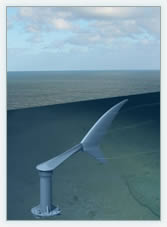
A tuna tail will save us? Maybe, if the tuna tail power generator works as hoped.

The good people at BioPower Systems hope to gain inspiration from tuna tails and kelp fronds to produce energy from the motion of the ocean.

The idea is to use natural structures as models for effective power generation from the low intensity but high power present in slowly-moving water. Since tuna tails are so efficient at converting energy into motion, why not reverse the process and convert motion into energy?

A great innovation if it works.

Thursday, August 03, 2006

More ocean oil drilling

The Senate approved more ocean oil drilling yesterday, and the House has approved a related bill. Both authorize more offshore oil drilling. Differences between the two chambers may prevent final approval.

Ocean oil drilling creates toxic contamination from drilling mud used for lubrication, along with occasional oil leaks.

Offshore platforms are believed by some to create positive effects for fish by serving as artificial reefs that produce more fish. Unfortunately, if fishing is allowed they can be a detriment to fish populations, by attracting fish that are easily caught, similar to FADs (fish aggregating devices). Without FADs, depletion can be the (sad) last refuge for fish because they are too sparse to catch effectively. With FADs, even depleted fish can be effectively caught.

Do we want more oil drilling off our coasts? Is this the highest and best use of our oceans?