Sunday, August 06, 2006

Polluted beaches

How nasty are US beaches? Dirtier than you might think.

Lots of beaches are being closed because too many bacteria make them unsafe for swimming. Ignore the signs and you might get sick, with vomiting and diarrhea and a high fever. Ugh.

The EPA says we're making progress, but clean beach advocates disagree. Read the info and judge for yourself. One scary fact, 8% of all tests found unsafe levels of bacteria.

Not exactly how we'd like things to be.

Friday, August 04, 2006

Acid oceans threaten sea life

A new horror story for the oceans, just when you thought you'd heard enough. Human-produced carbon dioxide has made our oceans more acid, harming ocean life, and the situation is only getting worse.

Ocean acidification is real, and it could worse for oceans than global warming.

Experiments suggest that realistic levels of acidification may cause calcium carbonate to dissolve. Not a big deal? It is if you're an animal like a coral or a pteropod, with a calcium carbonate skeleton. Imagine having your bones dissolve, sort of like osteoporosis for corals.

Ocean acidification is caused by increases in carbon dioxide from burning fossil fuels. Carbon dioxide dissolves in seawater and turns into carbonic acid, increasing acidity and (for you science geeks) lowering ocean pH. So just when we're all talking about global warming (or the myth of global warming) and it's harm (or benefits!), it seems we've been missing the boat, the real carbon dioxide threat may be ocean acidification.

Let's hope we'll find a way to avoid the ultimate bad acid trip.

NOAA photo: pteropod

Thursday, August 03, 2006

More ocean oil drilling

The Senate approved more ocean oil drilling yesterday, and the House has approved a related bill. Both authorize more offshore oil drilling. Differences between the two chambers may prevent final approval.

Ocean oil drilling creates toxic contamination from drilling mud used for lubrication, along with occasional oil leaks.

Offshore platforms are believed by some to create positive effects for fish by serving as artificial reefs that produce more fish. Unfortunately, if fishing is allowed they can be a detriment to fish populations, by attracting fish that are easily caught, similar to FADs (fish aggregating devices). Without FADs, depletion can be the (sad) last refuge for fish because they are too sparse to catch effectively. With FADs, even depleted fish can be effectively caught.

Do we want more oil drilling off our coasts? Is this the highest and best use of our oceans?

Wednesday, August 02, 2006

San Francisco's sand dunes

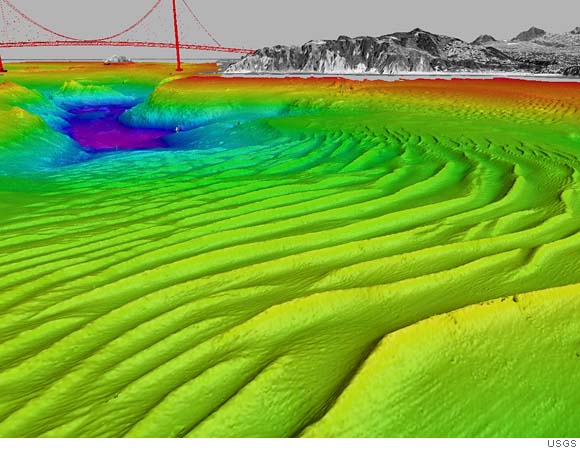
Who knew that the foggy city has magnificent sand dunes, up to 700 feet long and 30 feet high?
Nobody but us fishes, and a few octopi and friends, I guess, since the dunes are just outside the Golden Gate, under a couple hundred feet of water.

Another hidden surprise from the wonderful underwater world.

These are some of the largest underwater dunes on Earth, formed by the powerful Golden Gate tidal currents that routinely exceed 5 miles per hour, thanks to lots of water rushing in and out of a narrow bay mouth.

Add in a westerly wind at 25 mph (not unusual) and you get the lovable and intense "washing machine" conditions great for windsurfing under the Golden Gate bridge.

Tuesday, August 01, 2006

Unusual Oregon dead zone spreads, worsens

..."it could never happen here"...

Oregon's dead zone is bigger and badder this year, probably trying to compete with its more famous cousins like the one in the Gulf of Mexico.

The Oregon dead zone is now recognized as probably caused by people, despite learned opinion from a few years ago that it was a natural phenomenon.

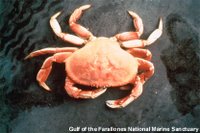
Low oxygen water has crept into shallow waters this year, and the darn thing is spreading up the Washington coast. Crab fishermen have found dead crabs in their traps, and dead fish have floated up onto beaches.

If you've never seen the Oregon coast, this is not where you expect a dead zone. Rough and sometimes craggy, with open beaches and not a lot of shallow water, the ocean off Oregon is swept by fairly strong currents and whipped by waves even in the summer. The water is usually cold and few people live on the coast. Overall, this is not a typical recipe for a dead zone (more typical = shallow, enclosed areas with lots of nutrient runoff and fairly immobile water where plankton blooms can cook up, sizzle, and then rot into a stinky deadened broth).

Nobody would have believed it if told a decade ago that a human-caused dead zone would be wreaking havoc off the Oregon coast. It just ain't how Oregonians think about the wild coast. Thunder and tarnation.


BTW, for the record, the dead zones are called that not because everything dies. Some wicked slimy things thrive in so-called "dead zones," and what dies is just all the nice things that people like to eat.