Showing posts with label ocean currents. Show all posts

Friday, February 19, 2010

Surfing Greenland

Sandy beaches, nice waves, and warm water in paradise...it's Greenland.

That's right, warm subtropical water is coming to Greenland, thanks to changing ocean circulation. This is one of the real bugaboos of climate change, way scarier for me than mild stuff like pestilence, disease, and Al Gore saying "I told you so." If ocean currents shift, we could see big changes fast, and we won't like them.

Oh wait...the subtropical water raging through Sermilik Fjord turns out to be only 4C, that's 39F. Warm for Greenland, but still as cold as your refrigerator. Not exactly most people's picture of a nice day at the beach. Of course, blogfish thinks it's a nice day at the beach, like the day I swam West Port Madison and found a flock of pteropods on leg 23 of Swim Around Bainbridge. But that's another story.

Now for some real ice surfing, since I teased you, check out the totally nutzoid video below of surfing on waves formed by glaciers calving. Whoa.

Susty.tv » Glacier Wave Surfing: Making the Most of an Opportunity? Pro Surfers Ride Melting Glacier Tsunami in Alaska from susty.tv on Vimeo.


You gotta ask yourself, where would I find this stuff if it wasn't for blogfish.

Tuesday, May 01, 2007

Melting arctic sea ice to chill Europe?

The Sea Around Us is many things, including the title to Rachel Carson's other book...and the title to my college course at the University of Connecticut in the early 1990s. As you ponder today's news about ice, currents, and Europe's winters, go back to her chapter on "the global thermostat" and see how she got oceans right too.

NASA scientists have discovered that sea ice in the arctic is melting much faster than predicted. The changes in the arctic may have serious consequences for major ocean current patterns, including the Gulf Stream that brings massive amounts of heat to the North Atlantic Ocean. In particular, loss of sea ice is likely to chill Europe and parts of North America, as part of the quirky hip-hop of global warming.

All because we depend on the massive "ocean conveyer belt" that moves water and heat in a worldwide circulation pattern. If you want to get really deep, look at the science of rapid climate change. And yes, it matters for fishing too.

Who knew that ocean currents matter? (besides Rachel Carson in the 1950's)

Friday, October 13, 2006

Who or what stirs the ocean?

Is it possible that paddling feet, fins, and flukes do more to mix ocean waters than big winds and currents? Maybe.

This surprising answer may force us to rethink how oceans work.

Tiny paddling krill do more to mix ocean waters than all other forces combined in a recent Canadian study. The krill feed near the ocean surface at night, then swim down deep during the day (presumably to hide). The swimming swarm moves enough water to win the ocean mixing contest.

Now oceanographers are ready with a whole new set of questions, like what about the passage of big whales or schools of fish--do they leave a changed ocean in their wake? And does overfishing reduce ocean productivity by slowing down nutrient transport?

This reminds me of the revolution in thinking that followed the discovery that salmon swimming upstream to spawn and die are a major source of nutrients for the growth of their offspring. Now we all accept that salmon fertilize tiny headwater streams and are a major source of nutrient transport from ocean depths to mountain ecosystems. Ocean-derived nutrients have been found in plants and bears on hilltops, and in wine made from grapes grown along salmon streams.

Science is now renewing ancient wisdom...krill can move an ocean.

Photo: Edgar, 1997 from http://www.woodbridge.tased.edu.au/mdc/Species%20Register/krill.htm

Tuesday, September 26, 2006

When London freezes over

Buried in the details of a dry "news release" is some worrisome news on ocean currents. Nobody is paying attention now, but they just might when London freezes over some winter.

Seems the North Atlantic Ocean is getting less salty, due to more rain. Why is this important? Because it just might slow down or stop the world famous "Atlantic Deep Water formation."

The sinking currents in the North Atlantic bring warm water north, and help keep Europe greener and warmer than other places that far north. Look at a globe, and see how far north Europe really is.

OK, not exactly front page news, but it's one of those rare moments when real oceanography has something important to tell us. Ocean currents, like sewage systems, only get noticed when they quit working.

Wednesday, August 02, 2006

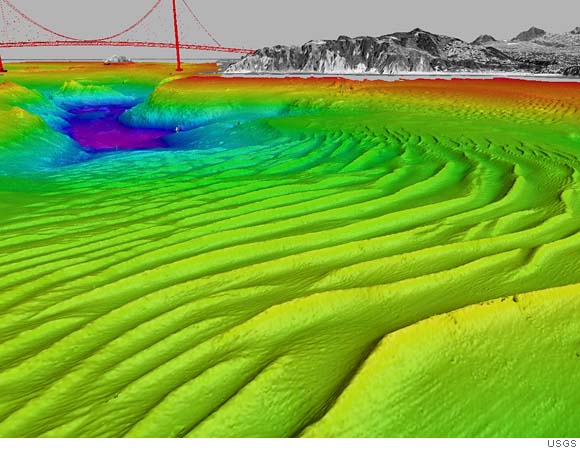
San Francisco's sand dunes

Who knew that the foggy city has magnificent sand dunes, up to 700 feet long and 30 feet high?
Nobody but us fishes, and a few octopi and friends, I guess, since the dunes are just outside the Golden Gate, under a couple hundred feet of water.

Another hidden surprise from the wonderful underwater world.

These are some of the largest underwater dunes on Earth, formed by the powerful Golden Gate tidal currents that routinely exceed 5 miles per hour, thanks to lots of water rushing in and out of a narrow bay mouth.

Add in a westerly wind at 25 mph (not unusual) and you get the lovable and intense "washing machine" conditions great for windsurfing under the Golden Gate bridge.

Tuesday, July 25, 2006

California ocean ecosystem collapse

For the second year in a row, ocean upwelling has failed and ocean animals are starving off California.

The Farrallon Islands northwest of San Francisco are ground zero in the crisis, where Cassin's auklets (puffin-like birds) are in the second consecutive year of "unprecedented" breeding failure.

“How many years in a row do you see this before you start raising your eyebrows?” said oceanographer Frank Schwing.

Blogfish told you earlier about the plankton crisis, and now we have confirmation that the effects are spreading up the food chain. This is not good.