Showing posts with label discovery. Show all posts

Sunday, February 13, 2011

Flamboyant new squid worm

It's a squid. No, it's a worm. It's a squid worm.

Scientists diving deep off the Philippines in 2007 found the Star Wars-looking squid worm. According to National Geographic:

"Relatively long, at nearly four inches (nine centimeters), the new annelid worm earned its moniker with a head that looks as if it's covered

in tentacles.

Its front end bristles with eight arms used for breathing—each as long as the worm's entire body—and two long, loosely coiled appendages employed for feeding.

As if that weren't enough hardware, six pairs of feathery sensory organs—the squid worm's collective "nose"—protrude from the new species' head. And along the length of its body, the worm has iridescent "paddles" for propulsion."

Just another day in paradise--the deep sea.

Tuesday, December 02, 2008

Peter's excellent deep sea adventure

Blog maven Peter Etnoyer actually did some real work, and he's getting some fanstastic results and real-world respect. So much for the stereotype that bloggers are do-nothings.

Here's his description of the new species he discovered, a new species of deep-sea bamboo coral, a calcareous sea fan called Isidella.

Even more stunning, here's a YouTube video of the actual moment of discovery. Set to music, it's a poignant chronicle of the great passion of discovery, and the clumsy, robotic moves involved in plucking a specimen off the sea bottom and pocketing it for later study.

Wednesday, June 13, 2007

Whale found with hundred year old harpoon

Traditional whale hunters in the Alaskan north found a century-old harpoon fragment in a bowhead whale, suggesting that the whale may have been 130 years old.

The whale was killed as part of a traditional Eskimo hunt, carried out under strict regulations. The weapon fragment came from an exploding cannister that hit the whale, but failed to kill it. After the whale was killed with a similar modern device last month, the piece was found when the whale was butchered.
The weapon fragment was unusual enough to date the time the whale was first shot, sometime between 1885 and 1895. The whale survived more than 100 years with the weapon fragment near it's shoulder blade.

Scientists have had trouble aging whales, so this finding is an important advance. Too bad the "Rutherford B. Hayes" whale had to be shot again to reveal this unpleasant reminder of an old whale hunt that it carried for more than 100 years.

Bowhead whales are endangered, with the Alaskan population doing better than anywhere else in the world. Subsistence hunting of a few whales each year is not expected to harm the populations.

Wednesday, March 14, 2007

Stunning new ocean discoveries

Craig Venter's excellent adventure has now produced results, and it's looking like a modern version of Charles Darwin's 19th century voyage aboard the HMS Beagle.

Using the new lens of genomics, the team's fabulous finds including doubling the number of known genes, along with mind-blowing potential for new energy sources and drugs. This is like inventing a new microscope and finding--surprise--lots of amazing new stuff we couldn't see before.

Overturning the view of open oceans as sterile and uninteresting, the study found a vast diversity of new bacteria and other microbes. The world of the wet, salty, and very small turns out to be where the action is in our oceans.

Perhaps most exciting, said study leader J. Craig Venter, is that the rate of discovery of new genes and proteins was as great at the end of the voyage as it was at the start, suggesting that humanity is nowhere close to closing the logbooks on global biodiversity.

"Instead of being at the end of discovery, it means we're in the earliest stages," said Venter, chairman of the J. Craig Venter Institute, a nonprofit gene research center.


My mind is boggled, my jaw has dropped and I've got a big bruise from being struck by awe. New ways of looking almost always produce new things found, but this is unbelievable.

So what do you see in the blue ocean pictured above? If you look right, you can see amazing intricate ecosystems of microbes with striking adaptations to the diverse microhabitats present. No longer is it just a clear blue ocean.

Wednesday, January 03, 2007

What's in the ocean?

Simple question, with a complex answer. This year's fabulous finds include shrimp that flirt with boiling water and birds that migrated 40,000 miles in 200 days (photo at right).

The Census of Marine Life is just beginning to yield results, and scientists are like kids in a toy store, giddy with joy. New animals, previously unknown...20,000 different kinds of bacteria in a liter of sea water...how ocean life has changed over time...and the success of conservation efforts (yay, I love that one!).

Get lost on their website, and please tell blogfish what you find! Also look for sub-sites, such as Tagging of Pacific Pelagics, with such treasures as real time tracks of blue whales, leatherback sea turtles, thresher sharks, and other migrating animals.

Photo: Migrating shearwaters, tracked by TOPP

Saturday, November 11, 2006

New drugs from ocean bugs?

Strange and wonderful bacteria live in our oceans, so why not use them to make fabulous new medicines? Or wondrous new energy supplies?

Because we didn't know enough about them until recently. With the acceleration of genomics, and star power from Craig Venter, ocean microbes have now hit the big time.

Ventner helped decode the human genome ahead of schedule, and for his 2 1/2 year summer vacation he sailed around the world on his own yacht and decided to bring his work (DNA sequencers) with him. This sounds like a boondoggle, but after his shocking private success competing with the government-funded human genome project, nobody laughs at his ideas anymore.

Now he's ready to use information from the expedition to design new ways to treat human diseases or new ways to fuel civilization's machines. This is an exciting new chapter in the long history of using ocean organisms to develop new medicines. It was different in the old days, when chemists extracted strange compounds from bizarre toxic sponges and the like. Now the focus is on interesting genes from strange microbes.

Will it work? I wouldn't bet against Craig Venter, he has a record of confounding skeptics.

Friday, October 13, 2006

Who or what stirs the ocean?

Is it possible that paddling feet, fins, and flukes do more to mix ocean waters than big winds and currents? Maybe.

This surprising answer may force us to rethink how oceans work.

Tiny paddling krill do more to mix ocean waters than all other forces combined in a recent Canadian study. The krill feed near the ocean surface at night, then swim down deep during the day (presumably to hide). The swimming swarm moves enough water to win the ocean mixing contest.

Now oceanographers are ready with a whole new set of questions, like what about the passage of big whales or schools of fish--do they leave a changed ocean in their wake? And does overfishing reduce ocean productivity by slowing down nutrient transport?

This reminds me of the revolution in thinking that followed the discovery that salmon swimming upstream to spawn and die are a major source of nutrients for the growth of their offspring. Now we all accept that salmon fertilize tiny headwater streams and are a major source of nutrient transport from ocean depths to mountain ecosystems. Ocean-derived nutrients have been found in plants and bears on hilltops, and in wine made from grapes grown along salmon streams.

Science is now renewing ancient wisdom...krill can move an ocean.

Photo: Edgar, 1997 from http://www.woodbridge.tased.edu.au/mdc/Species%20Register/krill.htm

Sunday, October 08, 2006

Waves travel 8,000 miles to smash iceberg

A violent storm brewed in Alaska sent waves 8,000 miles to break up a massive iceberg in Antarctica. To do this damage, the waves had to travel the entire length of the Pacific Ocean, northern hemisphere to southern hemisphere.

Scientists had been studying the iceberg for other reasons, and had sensitive instruments in place that could detect all of the details of the icebergs final shuddering breakup.

The sheer distance traveled by the storm waves stunned scientists, who reported "our jaws dropped." It's interesting to learn that even experienced experts can be stunned and surprised by the power of the ocean.

Wednesday, July 12, 2006

Real ocean monsters--giant rogue waves

Real monsters prowl the world’s oceans, rogue waves that can damage or sink even the largest ships, like this 80+ foot wave (right) breaking over an oil tanker. There may be as many as 10 of these monsters at a time looming somewhere on earth, up to 198 feet high. Until recently, scientists thought ocean waves could not get this large and scary.

What are rogue waves? They are monster waves produced when more typical "big" waves stack up on top of each other. They may be more common where strong winds blow opposite strong currents, and the resulting maelstrom creates irregular big waves with the potential to escalate to freakish heights.

Thought to be mythical until just the last few years, science now shows rogue waves to be real. What other monsters lurk hidden in our oceans?

Tuesday, June 27, 2006

Cold water coral discovery off Washington

Coral jungle discovered in the cold Pacific waters of the US northwest.
"It was really breathtaking," said researcher Mary Sue Brancato, describing "huge red sea corals atop boulders that had rockfish all over them."

Sadly, most of the sites have been damaged by fishing. Some were "festooned" with abandoned fishing gear, and others were crushed or overturned, with the telltale tracks of bottom-trawling fishing nets nearby.

Despite being in the Olympic Coast National Marine Sanctuary, most of the sites are unprotected. Recently enacted coral protection zones were placed elsewhere, where few people fish, at the behest of the fishing industry.

Who's driving the boat?

Sunday, June 04, 2006

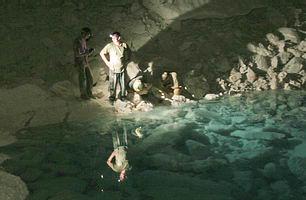
New ecosystem found in cave

One hundred meters below the surface of the earth, an ancient and thriving cave ecosystem was found recently. So far, scientists have found eight species living in the cave, and all eight are previously unknown.

The cave includes marine and freshwater portions, and is probably 5 million years old, said scientist Hanan Dimantman.

I guess there is something new under the sun, although in this case it's hidden under 100 meters of rock.

Tuesday, May 16, 2006

Fish from the sky

The strange saga of salmon in the Columbia River just got a new chapter.

Coho salmon smolts 7-8 inches long disrupted a track meet in Astoria, Oregon when they fell from the sky onto the javelin throwers.

This bizarre event happened when hundreds of thousands of young hatchery-raised salmon were planted in the lower Columbia River, and birds began catching fish and flying around over the nearby track meet, squabbling over who got to eat them.

These are the same birds that we humans have been squabbling about and harassing, because they've been eating too many of "our" expensive hand-raised salmon.

...all because we were promised that we could have both dams and fish, and it's turned out to be just a bit harder than expected...so now we spend BILLIONS raising salmon, driving them around in barges and trucks, and trying to stop birds and fish and sea lions from eating them in the unfriendly habitats of today's dammed river...

Makes me want to go back in time and promote the brave fish biologists who said the dams would kill salmon, and fire the ones who ended up running the agencies because they said we could have our river and damn it too.