What happens when a predator wanders by? Do you change your behavior?
Now we know that scary predators can change the ecology of important habitats, and this "ecology of fear" makes a difference. Wolves affect grazing herbivores and may protect sensitive habitats. Meanwhile sharks scare dugongs out of shallow water areas (see video below).
I've personally seen harbor seals flatten themselves against the bottom in big shark habitat, and the behavior looks so dramatic that absence of sharks would probably make a difference in what seals eat, etc.
Tweet
Showing posts with label sharks. Show all posts
Showing posts with label sharks. Show all posts
Friday, November 12, 2010


Wednesday, April 08, 2009
Somebody ate a megamouth shark
 This is sad. Megamouth shark number 41 (it's the 41st megamouth ever seen) was eaten in coconut sauce in the Philippines. It's ironic, considering that the region is the home of whale shark-based tourism, so they ought to know better. They used to eat whale sharks, now they sell trips to see whale sharks.
 Even if the megamouth was dead when found, there must be a more dignified fate than eating it.
Megamouths are large filter-feeding sharks, first discovered in 1976. Perhaps the world's rarest fish. Tweet
Monday, March 30, 2009
Shark fin soup endangered
 Younger asians are shunning shark fin soup, partly because of expense but also because of campaigns by environmentalists. Now it's shark fin soup that's endangered, and there's new hope for sharks.
 According to SeafoodSource.com:
In Singapore, the Association of Chefs has pulled the soup from the menu at its recent annual dinner, which represents a major shift in attitude toward this traditional Chinese dish.Shark catches are down in parts of the world that catch a lot of sharks, so maybe we're on the right track. But let's wait until the world economy improves and see if worldwide shark catches increase. Then we'll know if it's money or ethics that are saving sharks.
Singapore University students report that very few people would eat shark fins, partly because of the expense, but also because they're opposed to shark finning.
The British wildlife group Traffic says that with increasing access to information via the Internet, younger Asians are rejecting many of their parents' culinary traditions.
Stop by The Shark Alliance if you want the latest info from the world's experts on shark conservation. Tweet
Thursday, March 05, 2009
Dolphin "safe" tuna
 Dolphin "safe" tuna is an ecological disaster according to "WhySharksMatter." That's the nom de plume of a blogger interested in...guess what...sharks.
 That's him over there on the right, next to the guy in blue.
He has a strong opinion on dolphin-safe tuna and he has a point. But there is also a point on the other side, and it's a good chance for a rousing debate.
Who's right depends on what you value more, dolphins or broader ocean ecosystem health. At least that's the way I see it. We could protect dolphins totally during tuna fishing only if we're willing to allow other animals like fish and sea turtles to suffer harm and become depleted (or further depleted).
Dolphin lovers might say that protecting dolphins from harm is more important than saving sea turtles or fish. How do we balance? There is no scientific answer to that question, it's about values.
Who's out there with an opinion? You can argue it here or over at the home waters of Why Sharks Matter. Tweet
Sunday, September 21, 2008
Great white sharks attacking seals
Having a bad day at work? Well it could be worse...you could be a seal trying to swim through a small channel out to the open sea to find some food. What happens? Somebody finds food.
Watch the video, and be glad you've got it easy.
BTW, these sharks leaping clear out of the water are something like 15-18 feet long and weigh about a ton. That's almost as big as your car. Tweet
Sunday, April 27, 2008
Shark bite hits close to home
 Swimmer killed by great white shark. A very rare event, but this one hits close to home. I used to swim on this beach in Southern California.
 Worrying about shark attacks is silly, the risk is very, very low. But it's hard to avoid picturing the horrendous image of being held in the mouth of an 18-foot long, 2,000 pound shark. Especially after watching this shark attack video. I do NOT want a piece of that action.
When I was in graduate school in the 1980s, I used to swim on the beaches of San Diego County, including Solana Beach where the recent fatal shark attack occurred. It was great fun to swim out around local buoys or across coves, sometimes up to a mile across some deeper water. Occasionally, I would get a creepy feeling, and ignore it and keep on swimming. This time, it was real for one swimmer. Tweet
Saturday, April 26, 2008
Sherman's Lagoon on saving sharks
 Want to know what can happen to a shark if he's not careful? See what happens to Sherman of Sherman's Lagoon as he gets his fins sliced off, reattached, and lives through the whole ordeal, as Sherman's Lagoon takes a stand for saving sharks.
 Here's the opener from last Sunday, and if you go to the Sherman's Lagoon website you can watch Sherman's adventure over the next week (April 14-20, 2008). I don't want to spoil it for you, but it does involve an online bidding site (see toon above--Sherman tries to get his fins back).
In the real ocean, most sharks aren't so lucky and getting their fins sliced off is a one way trip to death. Too many sharks are getting killed for their fins, and courageous cartoonist Jim Toomey is to be congratulated for taking a very public stand for shark conservation, in addition to writing a very funny comic strip.
Thanks Jim. I've always wondered what cartoonists are like, and I had the privilege of meeting Jim and finding out. He's a really funny guy, no kidding! Dinner with Jim is an adventure. Tweet
Friday, November 30, 2007
Shark safe surfboards?
 If you wanna surf with sharks, maybe you should try Sharkcamo gear. It's stripes for your board or body that are hoped to repel sharks.
 Sharkcamo was created based on the scientific fact that Mother Nature protects certain species of animals with distinct coloration patterns. The technical name for this phenomenon is aposematic pattern coloration.
 The sharkcamo guys claim they've tested their theory, and it works.
 I'm skeptical, but it can't hurt. And they look good anyway. Tweet
Friday, November 09, 2007
Great white shark frenzy resembles fraternity party
Watch this video for an amazing look at a great white shark feeding frenzy that results in the sharks appearing drunk and sexually active. It reminds me of a fraternity party, except fed by whale blubber instead of take-out pizza and beer.
A whale carcass off South Africa attracts 27 large great white sharks, with the sharks lining up to eat 30-40 pound bites of whale blubber. As the sharks eat more and more, jostling each other in the process, they begin to appear intoxicated, moving slowly around the carcass and bumping into each other, the carcass, and the film crews boats and observation cage.
Finally, the sharks appear sexually aroused and active, although actual mating is not observed. Perhaps this takes place upstairs in the more private rooms. The film crew believes this may be the largest congregation of large great white sharks ever observed, and the closest thing to observing white shark mating.
One scientist says this film supports his theory that white shark mating may occur after large aggregations of sharks finish a feeding frenzy.
Stunning video. I don't know if the commentary is accurate, but take a look for yourself.
Hat tip: Sea Notes Tweet
Thursday, July 05, 2007
Great white shark attack on seal
Amazing, super slow motion video of a great white shark attacking a seal. The shark hits the seal from below, flying way out of the water as the attack is complete. Unbelievable, said to be from Planet Earth.
Friday, June 15, 2007
Corals, sharks fail to win international protection
 Down to the wire, an international conservation effort failed for spiny dogfish sharks. Even worse, previous action to conserve precious corals was overturned.
 The international intrigue of the CITES (Convention on International Trade in Endangered Species) convention yielded some conservation progress in liminting trade of sawfish, but sharks and corals will have to wait for another time.
Early announcements of coral protections turned out to be premature, as conservation opponents "re-opened" and overturned the Committee decision to limit trade in endangered precious corals. More later as details are available, including who led the anti-conservation charge (usually Japan).
The trend is in our direction, and this is merely a speedbump in the race to conserve. Tweet
Friday, March 30, 2007
Man bites shark
Again & again & again, until some large sharks are nearly extinct. Overfishing of sharks is changing our oceans.
 Recent evidence shows how overfishing of sharks, by removing apex predators, can undo ocean food webs. The problem is so bad that there are few places on earth where sharks and other apex predators remain abundant.
Slow to grow and reproduce, sharks have nevertheless been big winners of the evolutionary sweepstakes. Now humans are threatening to undo millions of years of success in a few decades of reckless fishing.
 Recent evidence shows how overfishing of sharks, by removing apex predators, can undo ocean food webs. The problem is so bad that there are few places on earth where sharks and other apex predators remain abundant.
 Studies of the relatively pristine Northwest Hawaiian Islands, in the fabulous Papahānaumokuākea Marine National Monument, provide a rare glimpse of a predator-dominated marine food web.
So beware, Mr. Shark, the new kids on the block are a real threat.
Tweet
Monday, January 08, 2007
Reef sharks declining in Australia
 Reef sharks are doing poorly on Australia's Great Barrier Reef, an area considered by many to be a healthy and well-managed reef system.
Fishing seems to be driving sharks into decline--unfished reefs have up to 10 times more sharks. This is an interesting result, sharks are mobile fish that don't stay put in no-fishing zones, so even mobile fish can benefit from protected areas.
Shark fishing is causing problems elsewhere in Australia, much of the fishing seems to be for illegal trade in shark fins in Asian markets.
Tweet
Tuesday, December 19, 2006
International protection for spiny dogfish?
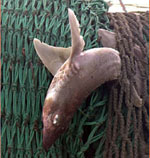 Europeans may save us from ourselves and protect spiny dogfish, just as hooks are being sharpened to go after spiny dogfish again in New England.
 The European Union will propose trade restrictions under CITES (the Convention on International Trade in Endangered Species).
Trade restrictions would largely shut down some unsustainable US fisheries since most spiny dogfish is exported.
Action by some US managers to allow fishing beyond scientific advice may ironically add weight to the CITES proposal by demonstrating poor management and the need for trade restrictions. Is this really what the Atlantic states fisheries managers were thinking when they voted for unsustainable fishing of spiny dogfish? Tweet
Tuesday, November 14, 2006
Limits on Antarctic shark fishing
Which is more common, shark bites man or man bites shark? Surprise, sharks have more to fear. Sharks are in trouble worldwide from overfishing.
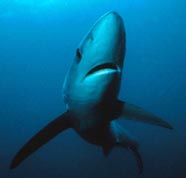 But there is good news for sharks in the cold Southern ocean, where managers have adopted the world's first international shark fishing limit. Shark fishing will be prohibited until we know enough to do it right. What a surprise, fishing is being regulated before fisheries have collapsed.
Elsewhere, shark fishing knows few limits, even though sharks are easily overfished. Fueled by intense demand for shark fin soup, fishing often exceeds the reproductive abilities of sharks.
Who needs sharks? We do, if we want to keep ocean ecosystems intact. Sharks play a vital role in keeping coral reefs healthy, and they are vital predators in all of the oceans ecosystems.
If only we could learn to do it right everywhere. Sharks are in trouble around the world, and even in the "advanced" U. S., we have a poor record at preventing overfishing of sharks. Tweet
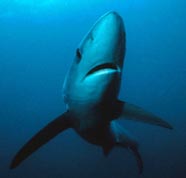 But there is good news for sharks in the cold Southern ocean, where managers have adopted the world's first international shark fishing limit. Shark fishing will be prohibited until we know enough to do it right. What a surprise, fishing is being regulated before fisheries have collapsed.
Elsewhere, shark fishing knows few limits, even though sharks are easily overfished. Fueled by intense demand for shark fin soup, fishing often exceeds the reproductive abilities of sharks.
Who needs sharks? We do, if we want to keep ocean ecosystems intact. Sharks play a vital role in keeping coral reefs healthy, and they are vital predators in all of the oceans ecosystems.
If only we could learn to do it right everywhere. Sharks are in trouble around the world, and even in the "advanced" U. S., we have a poor record at preventing overfishing of sharks. Tweet
Monday, October 30, 2006
Spiny dogfish-dead fish swimming
 Who will stand up for the troubled spiny dogfish? These small sharks that fishermen love to hate were targeted after their favorite fish like cod were fished out.
Following a quick fishery boom and bust, the preferred mature females (larger and more profitable) have been fished out in the Atlantic and elsewhere. With few mommies and no babies, these long-lived fish will take decades to recover.
Unfortunately, roving male dogfish are bothering fishermen who find their nets and lines otherwise empty. Their solution? Blame the dogfish, nevermind the decades of overfishing that are the real reason they can't catch cod.
Now, fishermen are hoping to restart the dogfish derby, and dogfish have few friends. Lacking an image makeover, the best hope for spiny dogfish is international trade sanctions, stay tuned. Tweet
Thursday, May 11, 2006
Magnets reduce longline bycatch
 Can magnets help save depleted and vulnerable shark populations?
The World Wildlife Fund is betting yes, and supporting the innovative work of Michael Hermann. He has found that putting magnets on longlines targeting swordfish or tuna can reduce wasteful bycatch of sharks. This idea won the $25,000 grand prize in WWF's annual Smart Gear competition.
Shark bycatch is a global problem, and a full 20% of the sharks that have been assessed are threatened with extinction, according to the IUCN red list of threatened and endangered fish worldwide.
Selective fishing is good and will improve the long-term sustainability of our use of fish...and maybe I should pay more attention to those claims that magnets will cure what ails me. Tweet
Subscribe to:
Posts (Atom)