"predators like tuna, cod and swordfish have seen their numbers drop by two-thirds over the past century, while small prey fish such as herring, caplin and anchovies have doubled."

"predators like tuna, cod and swordfish have seen their numbers drop by two-thirds over the past century, while small prey fish such as herring, caplin and anchovies have doubled."
Biologists are strange, and that really shows up when they start thinking and talking about poop. Witness biologist Alistair Dove talking about the lure of dipping a net to sample the poop of a whale shark, the world's biggest fish:“Nobody has done this analysis yet,” said Dove, who referenced a scene from Jurassic Park, when Laura Dern’s character is ecstatic at the chance to poke through a pile of dinosaur droppings. “It could be a literal gold mine.”
With a fresh sample, researchers could perform high-powered chemical and genetic analyses of its contents, learning in precise detail what these threatened giants consume in the wild. Dove is especially curious about their digestion. In aquariums they thrive on a relatively spartan diet, suggesting high efficiency in converting food. But a colleague on the research trip had observed whale shark defecation first-hand, and said their food was barely digested.Tweet
“He says it comes out looking much the same as when it goes in,” said Dove. “Maybe they’re efficient when food is scarce, but when they find a good patch, their efficiency drops in favor of gluttony. They’re eating so much, they just push it through.”
That colleague happened to find a group of whale sharks feeding — a spectacular affair, in which scores swim in a synchronized frenzy, sucking up water and food, and discharging wastes on the spot.
“Pooping events may play important oceanographic roles,” concentrating surface nutrients and delivering them to the water column and seafloor, said Dove. Scientists now think that baleen whales perform just such a task, and may be vital to nutrient circulation in the ocean.
Dove estimated the main plume in the photograph to be 30 feet long and 20 feet wide, and the smaller about 8 feet by 10 feet. If it’s three feet thick, the nutrient slurry would have a volume of 2,000 cubic feet. “Imagine you’ve got a big aggregation, dozens or hundreds of whale sharks, doing this all at the same time. That’s a lot of nutrients,” he said. Dove hopes to collect samples from just such a group.


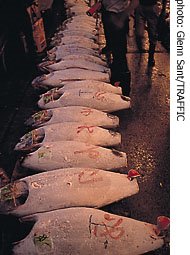
That's a pile of money for a fish, no wonder bluefin tuna are vanishing.
It's called a goonch, and it's a catfish that can get really big and is said to be eating people in India and Nepal.
Celebrated with a glittering party, the world gathered to say goodbye to the bluefin tuna. At least, that's what happened in Barry Foy's satirical piece on feasting the beast to extinction. 
Face to face with fish bigger than me, maybe 20 of them. Wow. I was swimming along in water about 20 feet deep, and there they were, all around me. Double wow. Not every one bigger than me, but all of them 4-6 feet long, maybe more. Shiny silver tarpon, milling around. They let me come almost within touching distance, then slipped slowly away. 
Tweet
Fishing and fishermen can be strange, and bluefin tuna fishing is the strangest. Dedicated bluefin anglers will fish day after day, sometimes a whole season, with no success. They'll even curse other fish that get in the way, inlcuding fish that would make others cheer. 
It's good to be fat, at least in the fish world. So nobody's cheering about the skinny bluefin tuna in Maine.
Throw back the big ones. It's a new principle in managing commercial fishing, designed to save the lobsters (or fish) that lay the golden eggs.
Here's a fish that was too valuable to kill: a century old "Teddy Roosevelt" rockfish--born when the roughrider was President.
What's a fisherman to do? The decline of white marlin is not in dispute, and the need for stringent action is obvious. Some credible fishing conservationists argue against listing, even though white marlin need help. ESA may not be the best tool to help these fish.
Depends on what you mean by "disappearing." Would you say that tuna are disappearing if only about 1 out of 3 are left? How do the two studies really differ? The new study shows that the biggest tuna have declined by 80%. This is actually quite similar to the 90% decline of large fish found previously. Both studies agree that the largest fish are at least 80% gone. That's a striking similarity. In the new study, the sharp criticism of previous results is based on relatively modest declines of a few smaller species such as skipjack tuna.
Interesting, the methods are different, but the findings are fairly similar when comparing big fish to big fish. By far the largest difference is the threshold for concern. So decide for yourself...is it ok to take most of the big fish out of the ocean?
The real conflict here is over the goals of fishery management. At stake is the future of our oceans and fish.
Tweet
Thus we have The Good Depletion; it allows us to maximize our fish catches. Or so say the equations. The Good Depletion has us liquidating the big fish, shrinking population size by 60-80%, and thus increasing the "productivity" of exploited fish populations. Mr. Hilborn says the decline shown in the figure is not a problem, because we're still catching plenty of fish.
In this context, the Japanese overfishing is a serious offense.
The Japanese government admits only modest and short term overfishing of bluefin tuna. However, they accepted stringent penalties that will cut Japanese bluefin quotas in half for 5 years.