Showing posts with label New England. Show all posts

Wednesday, April 08, 2009

Dysfunctional fishery management in New England

Yes, dysfunctional management in New England...again. Quoting from John Sackton of Seafood.com, which I can't link because it's a subscription site.

Here's a photo (right) to show what we're missing with this foolishness.


Dysfunctional Fisheries Management continues in New England (editorial comment)

SEAFOOD.COM NEWS - (Editorial Comment) by John Sackton - April 8, 2009 - Because of working for many years in both New England and Alaska, I have long been extremely critical of the New England approach to fisheries management because it has suffered from a fatal flaw: a failure to believe in the basic goal of maintaining fish stocks at their optimum level.

This underlying rejection of the fundamental goals of fisheries management is what has led the New England council time and again to fail to adopt effective measures to rebuild stocks, which now for a generation have been in serious decline.

Now, the council is again acting like a dysfunctional spouse in a domestic abuse case - unable to stop fighting the last war despite the intervention of grownups.

Yesterday, following largely the advice of lawyers based in Gloucester, the council voted again to affirm its rejection of NMFS interpretations of the mixed stock exemption, arguing explicitly that in a situation where many stocks are harvested together, the council has the ability to refuse to rebuild those stocks most at risk if it interferes with the other stocks being harvested at their optimum yield.

NMFS says simply that Magnuson requires action be taken to halt overfishing when a stock is overfished, and it does not matter whether that stock is part of another species complex that may be healthy or not.

In fact in the rest of the country, this is not even an argument. On the West Coast, the groundfish industry accepted severe restrictions due to the depletion of some specific rockfish species. Hitting the rockfish target bycatch even shut down the far larger whiting fishery for a significant time in 2008.

In Alaska, the council just wrestled for days with how to reduce salmon bycatch by the pollock fleet, and at the end of the process, not only did the pollock industry support the lower caps, but said in effect that they would be well under them due to the right combination of incentives. Here again, a billion dollar fishery is being managed partly to protect a smaller and weaker stock.

But the New England council turns this logic on its head. They say that the fact that winter flounder in Southern New England are severely overfished and declining is not a good enough reason to continue existing restrictions on multi-species catches.

At a time when NOAA is asking them to focus on a new sector based management system that will align the interests of the fishing community with long term stock rebuilding, the council is fixated on fighting the last war, seizing the opening given them by an ill-fated intervention of the courts on a two year old ruling.

Why does such a discrepancy in attitude exist? I think it harks back to the failure of regional managers to force allocation decisions on fishing communities. When the first hard TAC's were imposed in New England in the late 1970's and early 1980's, so much illegal fish was being landed that New Bedford unloaded more pounds at night under darkness than they did during the day when inspectors were present.

Other fishermen in Gloucester and Maine openly told me personally how they evaded catch limits by moving in and out of state waters, and taking various action to make their catches untraceable.

This spring, when the Gloucester auction was cited by NMFS for selling illegally caught fish - the reaction has been widespread indignation that they would even get a citation.

The council buckled back then (1982) and abandoned the idea that they would ever shut the fishery down to conserve stocks. Since then, a series of measures involving effort reduction, days at sea, gear modifications, closed areas -- all have failed to gain wide support despite the fact that they did make some progress in stock rebuilding.

Anytime the regulations had to be tightened, various port and state representatives ran to their political allies and said their fishery was being killed.

In 1994, this was first ended by a lawsuit by the environmentalists, in which NMFS admitted it had failed to implement rebuilding measures, and settled an agreement to begin to do so. Since then, it has been a continuous fight to keep those measures on track and working.

The latest row between the council and NMFS is simply another turn in this hundred years war.

The legal memo written by the Gloucester lawyers lays out the explicit argument that some stocks must be sacrificed if they get in the way of the maximum sustainable yield of other stocks. In other words - the fishery must be free to prosecute to the maximum economic value whatever stocks are strong, even at the expense of never ending overfishing on the weaker stocks.

As anyone who has studied ecosystems in fisheries knows, this a recipe for fishing down the trophic chain until jellyfish become the most valuable fishery. It is how many unregulated fishing ecosystems actually work. Harvesters target the most abundant species in turn until nothing is abundant.

In other areas of the country, the industry interests have become strongly aligned with the scientific and regulatory case for keeping multiple stocks at their maximum sustainable yield, and accordingly, the industry supports the needed compromises and effort to make this happen, so long as they have real input and some influence over how these measures are carried out.

In New England, we have not yet even arrived at the point where the industry supports the goals of the Magnuson act. That is why this seems like a fight that will never end.

I actually feel sympathy for Jane Lubchenco, who will address the New England council today. She is going to have to start their re-education from an extremely low level. It seems absurd to me that the head of NOAA has to spend her first month on the job fighting a political fire that should have been settled decades ago.

Sunday, March 22, 2009

New England's war on science

Fishing interests in New England have convinced politicians to launch a new war on science and common sense. They want to keep catching fish faster than they can reproduce.

New England's war on science might be dismissed as simple regional protectionism if it didn't include Senators Kennedy, Kerry, Snowe, Collins, Reed, Whitehouse and Shaheen. That's not just a few fishermen throwing elbows. Or is it?

With this list of Democrats and Republicans involved, it's interesting to note that New England's war on science is not a partisan issue. And a quick look at the record shows this war isn't new. The Seattle Times reported on this during Kerry's presidential campaign as a conflict between Kerry's good environmental record and efforts by the region's politicians to protect some small fishing fleets with some surprising political clout.

The science involved in this dispute has been reviewed, and reviewed, and reviewed. These reviews include one by the National Academy of Sciences in 1998, a series of reviews by a specially appointed team, including one in 2002, and one in 2008, and a review by the Inspector General's office in the Department of Commerce, designed to answer questions raisedby New England senators. In fact, this science may be some of the most intensely scrutinized science on earth. And every time it's been judged to be sound. So the science is beyond dispute. Why the problem? Because the science is inconvenient in saying that fishermen are killing too many fish.

In case you're a glutton for punishment (like me) in reading the history of the overfishing follies, check out this brief history of how we got into this colossal mess from the Conservation Law Foundation.

We know how the overfishing story ends, and it's not good. For just one painful example, we can look at Newfoundland and the collapsed cod fishery that still hasn't recovered 17 years later.

The Gloucester Times, that bastion of common sense, even goes so far as to put quotation marks around the word "overfishing." The science behind overfishing is simple, straighforward, and widely accepted, but in Gloucester there are still doubts. They're probably still buying subprime mortgages in Gloucester too.

Elsewhere, e.g. Alaska, the fishing industry is thriving under the federal law that requires fishing according to science-based limits. Here's a press release from an industry association in Alaska praising managers for following scientific advice and cutting fishing limits. So what's wrong in New England? New England fishermen are the victims of their own success. They've successfully fought responsible managment for so long that it's become a heritage. Whatever happened to Yankee thrift?

Monday, January 12, 2009

Free the lobster

An 80 year old lobster is headed back to the ocean now that a Manhattan restaurant gave in to please from animal rights activists.

George the 20 pound lobster, estimated at 80 years old, will be driven north to New Hampshire where a crustacean expert will "ease his transition" back to the wild before releasing him in protected waters near Kennebunkport, Maine.

The restaurant manager and executive chef said George was never going to be served, instead he served as a mascot.

A lot of to-do over a lobster.

The latest report says George is back in the ocean.

Wednesday, May 14, 2008

Plankton deficit in New England's ocean

If you love the ocean, then you love plankton. That's why a plankton deficit matters. Plankton feeds everything, including whales, dolphins and fish.

Last fall, the normally rich waters of George's bank were not so rich, and a plankton deficit was to blame. The normal fall plankton bloom didn't happen.

Perhaps more worrisome, a long-term warming trend is continuing in the region. Some fish that we care about are near their southern (warm water) limit in New England, and declines in these fish may happen if warming is maintained. Of course, this whole problem is much worse in the face of decades of persistent overfishing, which continues for some fish.

hat tip: Penobscot Bay Blog

Thursday, April 17, 2008

Whales vs. Lobster

That's the title of a great post by Jives over at The New Blue, a new blog on ocean issues from the New England Aquarium. Great stuff on whales and lobsters, and a heads-up on the newest Olympic sport, ray racing (photo at right).

Are comments allowed, Jives? I can't find a comment link so I can bet on the ray to win.

Wednesday, April 16, 2008

A side of whale with your lobster?

Would you still buy Maine lobster if it came with a side of whale meat? Well guess what, when you buy lobster you’re paying someone to lay a spider web of ropes in front of whales, and some of the whales get caught. Is that what you want to buy?

These days, we think of other people when we think about killing whales. Japanese whale hunts disguised as science, or Iceland and Norway resisting international management. But lobster fishing kills whales right here at home, despite more than a decade of work to protect whales. If you buy lobster, you own a piece of this problem.

Lobsters are caught with traps, and ropes are used to hold and retreive the traps (see diagram at left). Where lobster fishing is good, there are a lot of traps on the bottom and a spider web of ropes that float up in the water creating a potential trap for whales.

How bad is the risk to whales from catching lobsters? Entanglement scars have been found on 75% of critically endangered right whales, most probably caused by lobster fishing. Some of those whales die from drowning, while some escape with injuries caused by thrashing around in the ropes.

Lobstering isn’t the only thing that kills whales. Other fishing gear like gillnets can also catch and kill whales, and large ships can kill by running over whales. So why focus on Maine lobster?

The proud Maine lobster industry wants to fetch a higher price for their catch by promoting Maine lobster as sustainable. I have a problem with calling Maine lobster sustainable if catching lobster means also catching whales.

I believe lobstermen when they say they don’t want to kill whales, but they could do more to save whales. Lobstermen are fighting a new federal regulation designed to protect whales. It’s the latest in a series of usually-successful efforts to get powerful politicians like Senator Olympia Snowe to protect the lobster industry.

There is more the lobster industry could do, and the painfully slow progress on protecting whales is not what I would expect from a fishery that wants to be called sustainable. Sustainability includes protecting ocean ecosystems.

Here's the lobstermen’s side of the story, and a link to Maine Lobsermen's Association legal defense fund where you can contribute money to fight whale protection rules that lobstermen don't like. For more info, you can reach the Maine Lobstermen’s Association at info@mainelobstermen.org

Here's one example of a thought from the Jan. 2003 Massachusett's Lobsterman's Association newsletter, another place you can find the lobster industry's views:
"...I promised myself I would refrain from further criticism of developments in the whale theater of the absurd hoping, I guess, that some type of reason would prevail when dealing with the National Marine Fisheries Service’s efforts to save whales. I guess I was willing to believe that in the end they would see that fishermen are more important than the whales..."
Image: entangled humpback whale

Thursday, April 03, 2008

Phantom cod

Cod are missing from Chatham, Massachusetts. Where did they go? Chatham's fishermen are afraid that cod don't have enough to eat.

Interesting that the article makes no mention of overfishing. For at least the past couple of decades, and probably the past couple of centuries, we've been guilty of overfishing cod. That's catching fish faster than they can reproduce. Why worry about subtle, indirect harm when we're busy pulling too many cod out of the ocean?

So the cod are gone. I wonder if we'll finally do what it takes to bring them back. I worry when the focus goes away from overfishing before we're done solving that problem. Food for cod is important, there's no doubt about that. But focusing on herring while cod overfishing continues is like trying to do calculus before you learn to add and subtract. Let's stick to basics first, and tidy up that nasty little overfishing problem.

Tuesday, February 26, 2008

Fishing job losses, what's the cause?

Here's a sad and gritty story about fishermen leaving Maine. The cause? Other fishermen, or lobstermen to be precise.

This clash of fishing clans may put the final nail in the coffin of the traditional groundfish fishery in Maine. You'd think that lobstermen would give their groundfish brethren a hand in their time of need, but it it's not working out that way.

The issue is what to do with lobsters caught in bottom trawl nets. In Massachusetts and elsewhere, groundfish draggers (fishermen who catch fish by dragging trawl nets) can sell lobsters they catch while going after cod, haddock or other groundfish. It's incidental catch that helps pay the bills. As groundfish decline, lobsters are important sources of income to groundfish fishermen.

But lobster is king in Maine, and the lobster industry has made competition from trawlers illegal. You can only land lobsters caught in a trap. Last year, the state legislature considered a bill to give relief to the troubled groundfish fishery, but the power of the lobster industry crushed the bill.

So...Maine groundfish boats are selling their catch in Massachusetts, or moving to Massachusetts, so they can sell the lobsters. This exodus may spell the end of the Portland fish auction, the best place for fishermen to sell their catch in Maine, where business is down to about 10% of historic levels.

The lobstermen have a point, overfishing is really what killed the groundfish industry, not bans on selling lobsters, but if fishermen want a helping hand from others when they're in need, how about helping out your brethren?

Maybe the lobster industry will be the next fishery to fall on hard times, it's not impossible. Then, will people remember how lobstermen treated their fellow fishermen when they were in need?

Monday, September 03, 2007

Skinny bluefin tuna

It's good to be fat, at least in the fish world. So nobody's cheering about the skinny bluefin tuna in Maine.

Creative science found skinny bluefin tuna by relying on the meticulous work of tuna grader Robert Campbell. Since bluefin can fetch a scary price when prime, upwards of $50 per pound, much attention is giving to separating the prime from the not-quite-prime.

Fortunately for fishery science, what makes bluefin tuna good to eat also makes them good for making baby tuna. It's all about the fat content, like pretty much any good desert and most good food. Is it fatty? Then it's good.

There is no obvious reason for skinny bluefin tuna, there seems to be plenty of herring to eat. Maybe it's the influence of mainstream media and unhealthy body images.

Monday, August 27, 2007

New England fishermen are victims of their own success

My last grouchy words about New England fishing touched a few nerves with readers. Now that I'm out of Boston (after only 19 hours), and safely ensconced at an undisclosed location in Washington DC, I daresay more.

I know passions run high on cod in New England. My good friends, if we can't speak frankly with each other, how will we ever move forward? In that spirit let us go on, with the immortal words of Clint Eastwood as a benediction: "for what we are about to recieve, may we be truly grateful."

What is the essential truth of fishing in New England? Grizzled men in sou'westers gritting their teeth while tub trawling in a gale? Or a subsidy-bloated fleet dependent on overfishing and reliant on it's ability to bully government scientists and managers into allowing more overfishing?


Fishermen in New England are victims of their own success. They won generous government subsidies in the 1970s and 1980s, and had a spending spree at the boatyard and gear supply shops. Then they caught all of the cod while maintaining an official fishery goal of minimizing government interference in fishing until 1994. Overfishing all the while. How did they do it? Charisma, political muscle, and crocodile tears.

The result? Twenty-five years in a row of cod overfishing in New England, severely depleted fish, a collapsing industry, crumbling infrastructure, troubled fishing communities, and a persistent plea not to restrict fishing any further. One year (1994), fishermen caught over 70% of the cod that were in the water off New England. You don't need to be a fishery scientist to smell a rat in killing that many fish.

We're several years into the latest cod rebuilding plan, WE'RE STILL OVERFISHING COD, and there's no recovery in sight. Cod remain flatlined near record lows that were viewed as catastrophic in 1994. Now, the baseline has shifted and that depletion looks normal.

Is there a plan to rebuild? Yes, there is, but it's the fourth rebuilding plan. Amendment 5 was the first in 1994, then Amendment 7 in 1996, then Amendment 9 in 1999, then Amendment 13 in 2004. That's four strikes. Three strikes and you're out, unless you're doing fishery management in New England. Note the graph below, which dates from 2004, just before New England missed badly on the fourth big swing.


Ugh. I don't usually inflict graphs on you, but this one is important. The stars in the graph are the promised "rebuilding" goals for each of the first 3 rebuilding plans. They promised success after five years. Can you spell "pie in the sky?" Note that there is another star waiting to be put on this graph. Somehow I just can't bring myself to update this tragic tale of fishing gone sour.

This story looks as bad as the proverbial communist "five year plans" for economic miracles that we learned to laugh at as schoolchildren. Every kid in New England should be learning this story.

Blogfish has been consistent in pointing out these problems, witness:

Cod overfishing spawns cod nursery ideas

Massachusetts fishery disaster: too much of a good thing

Requiem for the Grand Banks

The tragedy of overfishing in New England

Do we have the courage to write a new chapter for cod in New England? I have a feeling that step one is admitting that we have a problem.

On the positive side, I had a beautiful view of the moon rising over NY city as I flew from Boston to DC. And I had a window/aisle seat on a nice little American Eagle jet so I experienced no bycatch or habitat damage from neighbors.

My apologies to the rest of the Best Practices Working Group still plugging away in Boston. Hope it's going well, and sorry for ducking out early.

Sunday, August 26, 2007

Back to Boston, land of worst practices in US fishing

New England, land of the overfishing entitlement. Ironic place to have round 2 of the Best Practices workshop.

I'm re-reading The Political Brain by Drew Westen, good stuff on how to persuade. He talks mostly about elections, but it's applicable to any kind of persuasion. Leads me into a few thoughts on the New Atheists who are looking to smack around the religious right. Hmmmm...probably suicidal to go into the middle of that fight.

For those who think ENGOs do it for the money, try this on. I got crammed into a middle seat on American flight 818 from Chicago to Boston, 24 E between a man so fat he couldn't put the armrest down and had his own personal seat belt extender. On the other side was a LARGE woman with 3 times too much luggage, most under her (our) feet and seats. Yeah, I do it for the bling. Is this how Frank Dulcich rides around the country?

But speaking of New England and the overfishing entitlement, Drew Westen recommends calling immoral policies by their real name. And, to quote:

When you find yourself afraid to move for fear of being branded, you know you've bought into the other side's frame and you'd better sell your shares.


So the "rebuilding plan" for New England cod doesn't even end overfishing? And we conservation ENGOs are afraid to come out guns blazing for fear that we'll be called anti-fishing? What's wrong with this picture? I believe in seeking shared goals, but if they can't even be bothered to end overfishing, then where's morality and common sense?

And that's before we even start in on right whales... Deeply endangered, on 350 left on earth, but killed by lobstermen, who are putting 10 times too much gear in the water just to mark out their turf? And you thought we "saved the whales" in the 60s, right?

Tuesday, July 17, 2007

Ocean conservation: you can't get there from here

You can't get there from here. We need real conservation to save our oceans, and so far we're not getting real conservation. Some big changes are needed.

The water taxi from downtown to Boston airport was a good time to ponder the lessons from the best practices in US fisheries workshop. A perfect afternoon with a warm breeze and a nice city harbor view. It looks ok, so long as you don't look too deep. Just like US fisheries.

Boston Harbor is a fitting metaphor for best practices in US fisheries. Things are better than they were, but there's a long ways to go. And sadly, to borrow a New England saying, "you can't get there from here." We have some broken approaches that need major overhauls before we can get to real conservation.

Much of the Best Practices workshop was focused on getting fishing interests to accept the very reasonable "best practices" that currently exist. That means setting The Good Depletion as a goal. Leaving a few fish in the water to spawn is better than many US fisheries, but it's not good enough as a conservation goal.

So long as we still have fishing interests controlling the management of US fisheries, we won't get to real conservation.

Conflict of interest is the heart of the problem. Boring story to anyone involved in fisheries, but it's amazing to anyone else.

Fisheries are managed by appointed Councils where fishing interests have a clear majority. The appointees get a nice federal salary for writing their own rules. The Councils are called "advisory" but Federal Government can only block their action if it's illegal. And not much is illegal. The Councils have what appears to be a unique exemption from conflict of interest law. The law simply does not apply. Conflict of interest is legal, and it's the normal way fisheries operate. Zowee, that's a nice gig if you can get it. Write the rules, and then go make money working under the rules that you wrote.

Monday, July 16, 2007

Cod overfishing spawns cod nursery ideas

Things are really bad when people on Martha's Vineyard are trying to start a cod nursery to re-seed local waters with cod.

It's a sad day when we can't rely on natural cod reproduction to grow cod in New England. Fishery management has truly failed when people are so desperate for solutions.

I'm glad to see people trying to solve problems with a cod nursery. But I worry that they'll end up doing more harm than good. See the sad history of salmon hatcheries in the northwest for a lesson on how good intentions can go badly wrong.

When will we finally figure out that overfishing is bad for fish and bad for people? Is it really that difficult to understand?

Monday, July 09, 2007

Can money hold back the sea?

We'll find out on Nantucket. As a beach erodes, wealthy homeowners are engaged in a high-stakes battle to "just say no" to coastal erosion.

A foolish project on a geological scale, but one that makes sense in the here and now. What to do with a tenuous piece of land treasured by people with large treasure chests?

The Sconset Beach Preservation Fund is drawing a line in the sand and saying no to further erosion. They're looking to spend $25 million of their own money to dredge sand offshore, dump it on the beach, and then watch it slowly erode away. They understand that it's a temporary solution, and they'll likely have to do it again in a few years to keep their beach. Check out this interesting powerpoint presentation on the erosion control plan.

The amount of sand is big. For now, they want to move 260,000 dump truck loads. That's right, two hundred sixty thousand loads.

Strong arguments are made on both sides, possible impacts to marine life vs. cultural preservation. An interesting twist is that some of those arguing are used to getting their way in life. Like Cape Wind, the wind power electricity generation station proposed in Nantucket Sound, this is no ordinary coastal development vs. environmental protection fight. (btw, lemme know if you wanna see blogfish do Cape Wind)

Folks, it ain't gonna work. You may win a few years, but the great mother ocean will take what she wants. And she seems to want your land.

Thursday, June 21, 2007

Herring get a hearing in New England

A new conservation alliance in New England is airing herring overfishing concerns. And judging from the media attention, people are beginning to listen.

The goal of the herring alliance is to protect this small fish that is “New England’s most important fish” because of the role it plays in the marine food web. Makes sense to me, if there's no fish food, then there's no fish.

Already, some battle lines are being drawn, but the most interesting reaction came from blogger John Sackton over at The Winding Glass.

John worries that the fishing industry is reacting with futile knee-jerk opposition.
Unfortunately, the industry is reponding in the old manner: the TAC should be bigger, the problems are exaggerated. This is going to lead to a showdown that they cannot win....

he continues
...New England has been cursed as the "middle east" of fisheries management, where there has been no peace for 30 years. The herring fight is likely to continue that poor record.

In Alaska, the basis of much of the strong managment has been an industry willing to put up money for science, to pay for observers, to respond to issues, and in general act as a partner interested in solving legitimate scientific issues, knowing that to fight all the time was a recipe for more and more restrictions, but to uphold scientific principles was a recipe for industry longevity.


Well said, John. If only the rest of the industry was as forward looking as John Sackton. I don't agree with everything he says, but at least he's got some sense on.

Thursday, April 12, 2007

Massachusetts fishery disaster: too much of a good thing

New England's cod fishermen are victims of their own success. Now the governor of Massachusetts wants a federal disaster declaration so he can get federal aid for the victims.

How did this happen? New England's fishermen are too good at the spin game and they've spun themselves into disaster. They paint a "woe is me" tale of beleagured victims, and ask for permission to overfish for just a few more years. Years turn into decades, and there are no cod left to catch.

Consider those great conservationists of New Englad. Politicians like Barney Frank and Ted Kennedy (among others) get very good lifetime scores from the League of Conservation Voters. But when it comes to conserving fish, they bow to their handful of fishing constituents and call for softening federal rules against overfishing.

Thus we get the overfishing entitlement in New England (and a few other places). This is one sad and tired story. With the total collapse of the Newfoundland cod fishery hanging over the northeast like a sword, how can it be that anyone dares to call for more overfishing?

The only hope for New England's cod fishery is some tough love to break the overfishing entitlement. Cries to save the infrastructure and keep people afloat ring hollow when they're just another in a long litany of cries that justfiy decades of overfishing.

Many fishery problems deserve forbearance and outside support, but not this one.

Wednesday, March 21, 2007

Requiem for the Grand Banks

Fishing off the edge of the Grand Banks in thousands of meters of water. A joke in 1982, earnest fishing business in 2007. This spells trouble for deep water fish.

My first exposure to the Grand Banks was in 1982, as a young student on a research trawler. We left from Newfoundland and fished the deep water around the Grand Banks, looking for deep sea fish that only a scientist could love...or so we thought. We fished in water so deep that it took nearly 2 hours just for our net to reach the bottom. It was hard fishing that nobody else would bother with...until all the easy fish were gone.

We'd haul up a squirming mass of
rattails & eelpouts, fish not fit for market. And then a squirming mass of scientists would descend on them with instruments in hand. We were the weirdos back then, nobody else would bother fishing like us when the world's richest cod fishery was going on nearby.

Fast forward to 2007, the cod fishery is closed and people actually
catch and sell rattails on purpose There are even worries about overfishing of rattails and other deep sea fish. In a mere generation, we've driven some rattils close to extinction. How have we sunk so low?

Somehow, we've managed to
kill the cod that once seemed infinite. We fished them out, closed the Grand Banks cod fishery in 1992, and still the cod aren't coming back. Even a "closed" fishery kills too many cod to allow recovery.

This is a
tragedy of epic proportions, and we need a tragedian of similar measure. Who will tell this story? Will we find rattails in Hollywood, or eelpouts on best-seller lists? I don't think so. It's a crisis of no significance...

Back in 1982 our scientific fishing expedition was chased off the Grand Banks by the remnants of a hurricane. But the deep sea fishing business of today is not so easy to slow down.

Wednesday, December 20, 2006

The tragedy of overfishing in New England

The human cost of overfishing will be featured on national tv on January 2. PBS presents "A Fish Story," a film about the human costs of fishery management failure in the US. Check out the website for more information.

Two women are the focus, as they struggle to defend their fishing community in the face of collapsing fish stocks. Bloated fishing fleets, built by generous federal subsidies, are hammering their fish. Yet each fishermen says they have a right to continue. Making a plea for survival, they repeatedly ask for and win permission to keep overfishing to sustain their livelihood.

To me, this is a tragedy in the classic sense. Are our fishing community activists tragic heros in the classic sense?

Call it: "The tragedy of overfishing in New England"

An Aristotelian tragic hero must have four characteristics:

Nobleness or wisdom (by virtue of birth).
(Noble fishing heritage)

Hamartia (translated as tragic flaw, somewhat related to hubris, but denoting excess in behavior or mistakes).
(Support for overfishing)

A reversal of fortune (peripetia) brought about because of the hero's tragic error.
(Collapsed fish stocks)

The discovery or recognition that the reversal was brought about by the hero's own actions (anagnorisis).
(Stay tuned for the last act--wherein fishermen in New England realize the folly of the overfishing entitlement)

Tuesday, September 12, 2006

Scary invaders in Long Island Sound

Venomous and scary-looking Pacific lionfish are invading the US East coast, as far north as Long Island Sound.

Divers have captured hundreds of lionfish this summer. “For us to be finding that many, there must be thousands and thousands more out there,” said Todd R. Gardner, a biologist at Atlantis Marine World aquarium in Riverhead. “It’s a population explosion.”

Nobody knows how the lionfish arrived, what the impacts are, and whether they'll survive winter's cold water (doubtful).

Increasing Atlantic sightings suggest that lionfish are in the Atlantic to stay, at least in the warmer waters further south.

Wednesday, April 12, 2006

The Cape formerly known as Cod

Fishing was bad last year off New England. So bad that it was hard to find cod.

Time to think of a new name for Cape Cod, how about "Cape Jellyfish?"

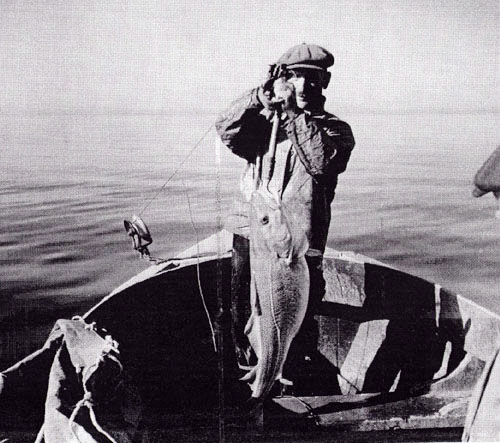
I wonder if this fisherman hauling in a cod would believe that he and his colleagues could really catch the last fish?

The sad news from Maine:
"New England fishery managers formally approved new restrictions for the region's struggling groundfish industry on Thursday. Some fishermen said the rules won't work, and a Canadian study raised new questions about the ability of cod populations to rebound...."-Portland Press-Herald