Sunday, August 12, 2007

More good fishing

One of my hopes in starting blogfish was to help build a community in support of conservation of fish and protecting our oceans. And finding like-minded fisherman was front and center.

Here's a link to another fisherman who, like Carl Safina, encourages fishermen to do right by fish. John McLean, writes on snookangler.com about the benefits, harm and obligations that come from conservation change like the Florida net fishing ban. I hope the good word spreads to everyone who wets a line.

John found blogfish and wrote a note about his new blog at shallowfish.com I've subscribed and I'll be reading. He's even got fish cartoons (top right). John, I hope you don't mind me borrowing one here.

Great fishing and bad fishing, the hows and whys

Ever wonder why fishing is great for some fish and lousy for other fish? Beyond the usual short-term problems like the (#*&$#($_+$# things just won't bite.

Carl Safina cuts through the crap and gives real answers about the hows and whys of good and bad fishing. In this great blog post, he describes two very different fishing trips, looks at them through the lens of a lifetime spent fishing, and states the plain and obvious truth.

Once again, everything we ever needed to know we learned in kindergarten. From "Fishing Without Limits" on Carl Safina's blog:

When we are stingy, something ironic happens: greed prevents us from getting what we need. If we would let nature recover, if we would leave some for another day, we would have enough.

As I often say, it’s OK to use nature; It’s not OK to use it up. As Robert Frost wrote:

“May something go always unharvested!

May much stay out of our stated plan.”

To take what one needs, rather than all one can take, means an end of neediness and the fulfillment of future desires.

This is a real fisherman talking about fishing right. Where have we gone so wrong that this sounds like a voice in the wilderness?

Saturday, August 11, 2007

Cure for the plastic bag plague

Plastic grocery bags suck if you're a sea turtle. It's not hard to understand why, they look a lot like a yummy jellyfish.

With this in mind, I was enthused to swing by my local grocery store and learn the results of their recent re-usable bag campaign. Town & Country Market has been giving away resusable bags with purchases, and tracking the number of times those bags come back into the store.

I'll spare you the numbers except one. They've already avoided using 10,000 plastic grocery bags. Wow, that's a lot more than I would have expected. And they're still giving away more re-usable bags! Since plastic bags are forever, this is a real accomplishment. All thanks to one grocery store.

The world isn't saved yet, but I thank Town & Country Market for stepping up to do this one good thing. I guess this is one vote for behavior change as a solution to the ocean plastic plague.

Friday, August 10, 2007

Seafood safety net has holes

Who will keep our seafood supply safe? Don't count on the US government, because our seafood safety net has holes in it.

Remember that Chinese seafood scandal? The one where some dangerous Chinese seafood was banned? Do you have confidence that the US government has fixed our seafood safety problem? Wanna buy a bridge?

According to the Associated Press, at least 1 million pounds of suspect frozen shrimp, catfish and eel from China arrived at U.S. ports under an "import alert," which meant the FDA was supposed to hold every shipment until it had passed a laboratory test. But that was not what happened. One of every four shipments the AP reviewed got through without being stopped and tested. The seafood, valued at $2.5 million, was equal to the amount 66,000 Americans eat in a year.

That's a lot of risky seafood, and some pretty large holes in our seafood safety net.

Just exactly who is being protected here? Seafood consumers, or the people that want to sell you lousy seafood?

When will the seafood industry wake up and smell the problem? There are inklings of concern, but the dominant response seems to be to circle the wagons and say everything is fine. That's a scary thought, and it's bad for the business.

Ocean wildlife refuges: a good idea

The fishing/anti-fishing smackdown is over in California's Channel Islands. Fishing is now prohibited in about 20% of the waters around the islands. Since 80% of the waters still allow fishing, why did this turn into such a fight? Most hunters and fishermen support refuges on land and in freshwater. Much ado about nothing?

Or...was it really a battle over the death of fishery management?

Almost everywhere, ocean fishing is managed by appointed panels that represent the interests of fishermen. Fishing restrictions are viewed with great skepticism. Limits are usually halfway solutions imposed after problems become severe. Fishery management specializes in closing the barn door after the horsefish is gone, and even then they only close the door halfway.

Oooops, everyone says when the fish and fishing are gone.

To be fair, there are some success stories, but they usually only come after a crisis has put religion into fishermen. Like the striped bass "success story" that came only after the severe striped bass collapse. And...oh yeah..we're already facing the next striped bass concern.
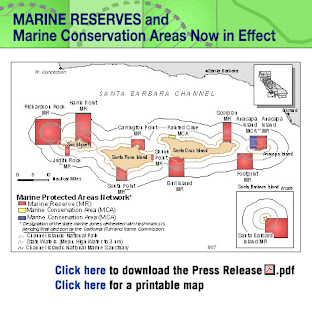
Enter, stage left, a new approach. Fish wildlife refuges in the ocean. No fishing in some areas, to ensure that some fish can live and reproduce unmolested. Yes, fish move, so no fish is totally protected, but that's a good thing because fishermen can benefit from the spillover from refuges. It works for migratory animals on land and migratory freshwater fish, so it'll work in the ocean. We already have ocean refuge success stories to prove it.

California is leading the US in creating ocean wildlife refuges. Now the federal government has expanded California's lead and closed federal waters adjacent to state fish refuges.

The fishing world is up in arms and raging. Fishery scientist Ray Hilborn accuses refuge supporters of using "faith-based science."

I guess the smackdown is just beginning.

Fishing interests have only themselves to blame. They had their way with fish for decades, and if they had done a good job this wouldn't be happening.